


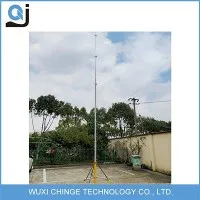


What is the torque requirement for extending a manual telescoping mast?
As a supplier of manual telescoping masts, I often receive inquiries about the torque requirements for extending these masts. Understanding the torque requirements is crucial for ensuring the proper operation and safety of the mast. In this blog post, I will delve into the factors that influence the torque requirement and provide some insights into how to calculate it.
Factors Affecting Torque Requirement
Several factors come into play when determining the torque requirement for extending a manual telescoping mast. These factors include the mast's length, diameter, material, and the number of sections. Let's take a closer look at each of these factors:
- Mast Length: The longer the mast, the greater the torque required to extend it. This is because the weight of the mast increases with length, and more force is needed to overcome the gravitational force acting on the mast.
- Mast Diameter: The diameter of the mast also affects the torque requirement. A larger diameter mast will require more torque to extend than a smaller diameter mast. This is because the larger diameter mast has a greater surface area, which increases the friction between the mast sections.
- Mast Material: The material of the mast can also influence the torque requirement. Different materials have different coefficients of friction, which can affect the amount of force needed to extend the mast. For example, a mast made of aluminum will require less torque to extend than a mast made of steel.
- Number of Sections: The number of sections in the mast also plays a role in the torque requirement. A mast with more sections will require more torque to extend than a mast with fewer sections. This is because each section adds to the overall weight of the mast and increases the friction between the sections.
Calculating the Torque Requirement
To calculate the torque requirement for extending a manual telescoping mast, you need to consider the factors mentioned above. Here is a step-by-step guide on how to calculate the torque requirement:
- Determine the weight of the mast: The weight of the mast can be calculated by multiplying the length of the mast by its density. The density of the mast material can be found in a materials reference book or online.
- Calculate the friction force: The friction force between the mast sections can be calculated using the coefficient of friction and the normal force. The normal force is equal to the weight of the mast. The coefficient of friction can be found in a materials reference book or online.
- Determine the torque required to overcome the friction force: The torque required to overcome the friction force can be calculated by multiplying the friction force by the radius of the mast. The radius of the mast is half of its diameter.
- Add the torque required to lift the mast: In addition to the torque required to overcome the friction force, you also need to add the torque required to lift the mast. This can be calculated by multiplying the weight of the mast by the distance from the center of the mast to the point where the force is applied.
Here is an example of how to calculate the torque requirement for extending a manual telescoping mast:
- Mast Length: 10 meters
- Mast Diameter: 100 millimeters
- Mast Material: Aluminum
- Number of Sections: 5
-
Determine the weight of the mast:
- The density of aluminum is 2,700 kg/m³.
- The weight of the mast can be calculated as follows:
- Weight = Length x Density x Cross-sectional Area
- Cross-sectional Area = π x (Diameter/2)²
- Cross-sectional Area = π x (0.1/2)² = 0.00785 m²
- Weight = 10 x 2,700 x 0.00785 = 211.95 kg
-
Calculate the friction force:
- The coefficient of friction between aluminum and aluminum is 0.4.
- The normal force is equal to the weight of the mast, which is 211.95 kg.
- The friction force can be calculated as follows:
- Friction Force = Coefficient of Friction x Normal Force
- Friction Force = 0.4 x 211.95 = 84.78 N
-
Determine the torque required to overcome the friction force:
- The radius of the mast is half of its diameter, which is 0.05 meters.
- The torque required to overcome the friction force can be calculated as follows:
- Torque = Friction Force x Radius
- Torque = 84.78 x 0.05 = 4.24 Nm
-
Add the torque required to lift the mast:
- The distance from the center of the mast to the point where the force is applied is 5 meters.
- The torque required to lift the mast can be calculated as follows:
- Torque = Weight x Distance
- Torque = 211.95 x 5 = 1,059.75 Nm
-
Total Torque Requirement:
- The total torque requirement is the sum of the torque required to overcome the friction force and the torque required to lift the mast.
- Total Torque Requirement = 4.24 + 1,059.75 = 1,063.99 Nm
Importance of Meeting Torque Requirements
Meeting the torque requirements for extending a manual telescoping mast is essential for ensuring the proper operation and safety of the mast. If the torque requirement is not met, the mast may not extend properly or may even collapse, which can result in serious injury or damage to the equipment.
In addition to ensuring the proper operation and safety of the mast, meeting the torque requirements can also help to extend the lifespan of the mast. By using the correct amount of torque, you can reduce the wear and tear on the mast sections and prevent premature failure.
Conclusion
In conclusion, understanding the torque requirement for extending a manual telescoping mast is crucial for ensuring the proper operation and safety of the mast. The torque requirement is influenced by several factors, including the mast's length, diameter, material, and the number of sections. By calculating the torque requirement and using the correct amount of torque, you can ensure that the mast extends properly and safely.
If you are in the market for a manual telescoping mast, I encourage you to visit our website to learn more about our products. We offer a wide range of Telescoping Mast for Antenna and Telescoping Mast For Antennas, as well as Winch Up Pole. Our masts are designed to meet the highest standards of quality and performance, and we are committed to providing our customers with the best possible service.


If you have any questions or would like to discuss your specific requirements, please feel free to contact us. We look forward to hearing from you and helping you find the perfect manual telescoping mast for your needs.
References
- Engineering Mechanics: Statics and Dynamics by J.L. Meriam and L.G. Kraige
- Materials Science and Engineering: An Introduction by William D. Callister, Jr.
- Handbook of Mechanical Engineering Calculations by Myer Kutz