




Hey there! As a supplier of portable towers, I often get asked all sorts of questions about our products. One question that’s been popping up a lot lately is, “Can a portable tower be used for wireless charging?” Well, let’s dive right into it and find out.
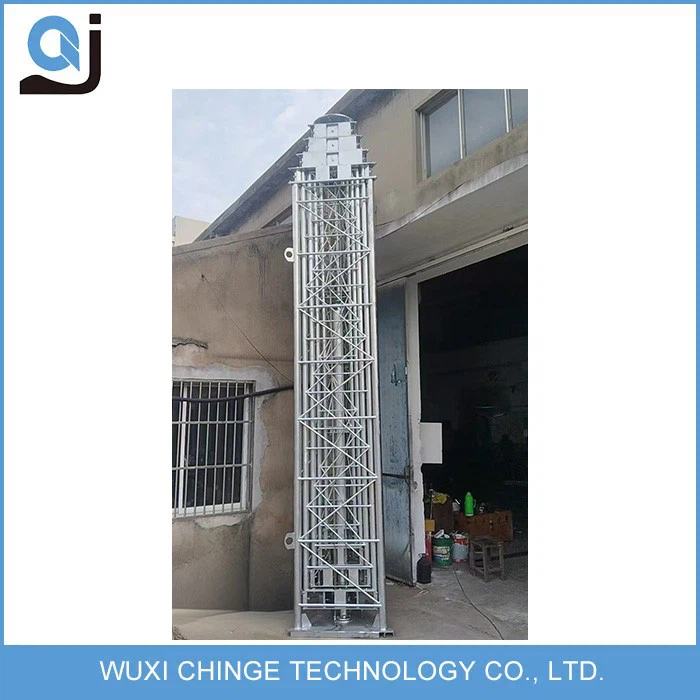
First off, let’s talk a bit about what a portable tower is. We offer a variety of portable towers, like the Military Telescopic Tower and the Telescopic Antenna Tower. These towers are designed to be easily transported and set up in different locations. They’re used in a bunch of different scenarios, from military operations to communication setups in remote areas. And then there’s the China COWs Cell On Wheels, which is a mobile cell tower solution.
Now, back to the question at hand: wireless charging. Wireless charging technology has come a long way in recent years. It’s based on the principle of electromagnetic induction. When you place a device with a compatible wireless charging receiver on a charging pad, an alternating current in the pad creates a magnetic field. This magnetic field then induces an electric current in the receiver coil of the device, which charges the battery.
So, can a portable tower be used for wireless charging? The short answer is yes, but there are some things to consider.
Feasibility of Wireless Charging with Portable Towers
One of the main factors is power output. Portable towers are typically designed to provide power for other equipment like antennas, communication devices, etc. For wireless charging to work effectively, the tower needs to be able to generate enough power to charge the devices. Most modern smartphones and other small devices require a certain amount of power to charge at a reasonable speed. For example, a standard wireless charger for a smartphone might need around 5 - 15 watts of power.
If our portable towers are equipped with the right power generation and distribution systems, they can potentially supply this power. Some of our larger portable towers are designed to handle high - power loads, so they could be modified to support wireless charging.
Another aspect is the range of wireless charging. Traditional wireless charging pads have a very short range, usually just a few millimeters. However, there are emerging technologies for long - range wireless charging. These use different methods like resonant inductive coupling or radio frequency (RF) energy transfer.
If we want to use a portable tower for wireless charging, we could potentially integrate long - range wireless charging technology. This would allow the tower to charge devices within a certain radius. For example, in a military camp or a remote communication site, soldiers or workers could have their devices charged without having to plug them in, as long as they are within the range of the wireless charging field generated by the tower.
Challenges and Solutions
Of course, there are some challenges. One big challenge is efficiency. Wireless charging, especially long - range wireless charging, can be less efficient than traditional wired charging. Energy is lost in the process of converting the electrical energy into a magnetic or RF field and then back into electrical energy in the device.
To address this, we can use high - quality components and advanced control systems. For example, using more efficient power converters and optimizing the design of the charging coils can help reduce energy losses.
Another challenge is interference. The electromagnetic fields generated by the wireless charging system could potentially interfere with other equipment on or around the portable tower. For instance, it could disrupt the operation of communication antennas or other sensitive electronic devices.
To mitigate this, we can use shielding techniques. Shielding materials can be used to contain the electromagnetic fields within a specific area, preventing them from spreading and causing interference.

Applications of Portable Tower - Based Wireless Charging
There are some really cool applications for this technology. In a military context, soldiers on the field could have their smartphones, tablets, and other communication devices charged wirelessly from a portable tower. This would be a huge advantage as it would reduce the need for soldiers to carry around multiple chargers and cables.
In remote construction sites or disaster - relief areas, workers could keep their devices charged without having to worry about finding a power outlet. The portable tower could be set up quickly, and the wireless charging feature would provide a convenient way to keep essential devices powered.
Cost - Benefit Analysis
When considering implementing wireless charging in portable towers, we also need to look at the cost - benefit ratio. Adding wireless charging capabilities to a portable tower will increase the cost of production. There will be additional components, such as charging coils, power converters, and control systems.
However, the benefits could outweigh the costs in the long run. For example, in a large - scale military operation or a long - term construction project, the convenience of wireless charging could save time and effort. Workers and soldiers wouldn't have to waste time looking for charging outlets or dealing with tangled cables.
Future Developments
The future looks bright for using portable towers for wireless charging. As wireless charging technology continues to evolve, we can expect even more efficient and long - range solutions. We might see portable towers that can charge multiple devices simultaneously over a larger area.
We're also looking into integrating smart features. For example, the tower could detect when a device enters the charging range and automatically adjust the power output to optimize the charging process.
Conclusion
So, in conclusion, a portable tower can definitely be used for wireless charging. There are challenges to overcome, but with the right technology and design, it's a feasible and potentially very useful application.
If you're interested in our portable towers and want to explore the possibility of using them for wireless charging or other applications, we'd love to hear from you. Whether you're in the military, construction, or any other industry that could benefit from our products, we're here to have a chat and see how we can meet your needs. Get in touch with us to start the procurement and negotiation process.
References
- “Wireless Power Transfer: An Overview,” IEEE Transactions on Power Electronics.
- “Advances in Long - Range Wireless Charging Technologies,” Journal of Electrical Engineering.