




In the dynamic landscape of modern communication, the demand for seamless connectivity has reached unprecedented heights. Whether it's a bustling music festival, a large - scale sports event, or a remote construction site, the need to support multiple users simultaneously is crucial. As a leading portable cell tower supplier, I am often asked about how our portable cell towers handle multiple users effectively. In this blog, I will delve into the technical aspects and strategies that enable our portable cell towers to meet the high - volume user demands.
Understanding the Basics of a Portable Cell Tower
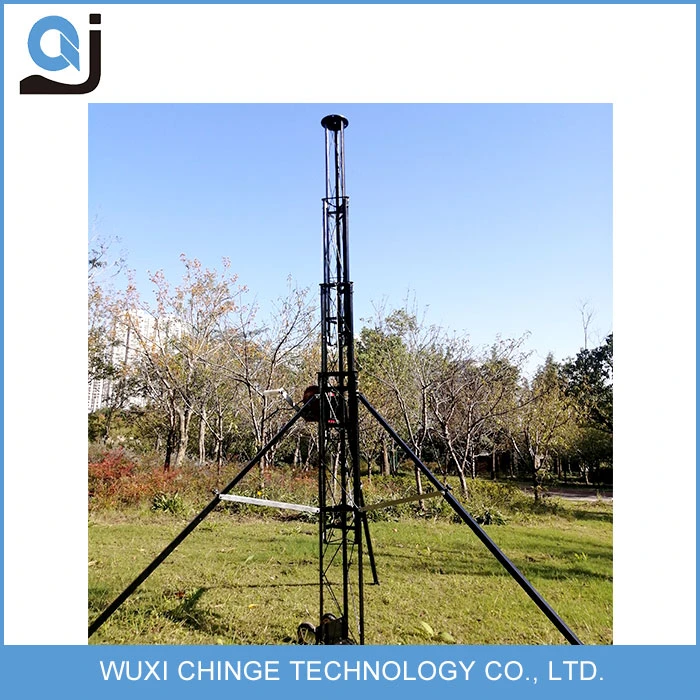
Before we explore how a portable cell tower manages multiple users, let's first understand what a portable cell tower is. A portable cell tower, also known as a Cell on Wheels (COWs) or a telescopic mobile tower, is a self - contained, mobile telecommunications facility. It can be quickly deployed to areas where temporary or additional cellular coverage is required. For instance, our Telescopic Radio Tower and China COWs Cell On Wheels are designed for rapid deployment and easy operation.
Spectrum Allocation and Bandwidth Management
One of the key factors in handling multiple users is spectrum allocation. Spectrum refers to the range of electromagnetic frequencies used for wireless communication. Our portable cell towers are equipped with advanced spectrum management systems that can divide the available spectrum into multiple channels. Each channel can be assigned to different users or groups of users, allowing them to communicate simultaneously without interference.
Bandwidth management is another critical aspect. We use sophisticated algorithms to allocate bandwidth based on the user's needs. For example, users who are streaming high - definition videos or conducting video conferences require more bandwidth than those who are simply sending text messages. Our systems can detect the type of data being transmitted and allocate the appropriate amount of bandwidth to ensure a smooth user experience.
Antenna Technology
The antenna is the interface between the portable cell tower and the users' devices. Our Telescopic Mobile Tower is equipped with high - gain antennas that can cover a large area. These antennas are designed to provide omnidirectional or directional coverage, depending on the deployment scenario.
Omnidirectional antennas radiate signals in all directions, making them suitable for areas where users are spread out evenly. On the other hand, directional antennas focus the signal in a specific direction, which is useful for concentrating coverage in a particular area, such as a stage at a concert or a sports field.
Moreover, we use multiple - input multiple - output (MIMO) antenna technology. MIMO antennas can transmit and receive multiple data streams simultaneously, effectively increasing the capacity of the cell tower. By using MIMO technology, our portable cell towers can support a larger number of users and provide higher data rates.
Load Balancing
Load balancing is a technique used to distribute the traffic evenly across multiple cells or base stations. Our portable cell towers are integrated with load - balancing algorithms that continuously monitor the traffic load on each channel. If a particular channel is overloaded, the system will automatically redirect some of the traffic to less - congested channels.
In addition, our cell towers can communicate with nearby existing cell towers to balance the overall network load. For example, if a large event is taking place in an area with an existing cellular network, our portable cell tower can work in tandem with the fixed - base stations to share the user load, ensuring seamless connectivity for all users.
User Authentication and Quality of Service (QoS)
To ensure that the limited resources of the portable cell tower are used efficiently, we implement user authentication mechanisms. Only authorized users can access the network, which helps to prevent unauthorized access and potential security threats.
We also prioritize the quality of service (QoS) for different types of users. For example, emergency services and critical communication users are given higher priority over regular users. Our systems can identify the priority level of each user and allocate resources accordingly, ensuring that important communications are not disrupted.
Capacity Planning and Scalability
As a portable cell tower supplier, we understand that the number of users in a particular area can vary greatly. Therefore, we focus on capacity planning and scalability. Our portable cell towers are designed to be easily scalable, allowing us to increase the capacity as the user demand grows.
We conduct detailed site surveys before deploying a portable cell tower to estimate the number of users and the expected traffic volume. Based on this analysis, we can select the appropriate equipment and configuration to meet the specific needs of the deployment. If the actual user demand exceeds the initial capacity, we can quickly add additional equipment, such as more antennas or base stations, to scale up the system.
Real - Time Monitoring and Maintenance
To ensure the continuous operation of the portable cell tower and the satisfaction of multiple users, we implement real - time monitoring systems. These systems can collect data on various parameters, such as signal strength, traffic volume, and equipment status. By analyzing this data, we can detect potential problems in advance and take proactive measures to prevent system failures.
Regular maintenance is also essential. Our technical teams are trained to perform routine maintenance tasks, such as equipment inspection, software updates, and antenna alignment. This helps to keep the portable cell tower in optimal condition and ensures that it can handle multiple users effectively over an extended period.
Conclusion
In conclusion, handling multiple users with a portable cell tower requires a combination of advanced technologies and effective management strategies. From spectrum allocation and bandwidth management to antenna technology and load balancing, every aspect plays a crucial role in ensuring seamless connectivity for a large number of users.

As a portable cell tower supplier, we are committed to providing high - quality products and solutions that can meet the diverse needs of our customers. Whether it's a short - term event or a long - term deployment in a remote area, our portable cell towers are designed to deliver reliable and efficient communication services.
If you are interested in our portable cell tower products or have specific requirements for your project, we invite you to contact us for procurement and negotiation. Our team of experts will be happy to assist you in finding the most suitable solution for your needs.
References
- Andrews, J. G., Buzzi, S., Choi, W. Y., Hanly, S. V., Lozano, A., Soong, A. C. K., & Zhang, J. C. (2014). What will 5G be? IEEE Journal on Selected Areas in Communications, 32(6), 1065 - 1082.
- Rappaport, T. S., Sun, S., Mayzus, R., Zhao, H., Azar, Y., Wang, K., … & Heath, R. W. (2013). Millimeter wave mobile communications for 5G cellular: it will work! IEEE Access, 1, 335 - 349.
- Tanenbaum, A. S., & Wetherall, D. J. (2011). Computer Networks (4th ed.). Prentice Hall.