


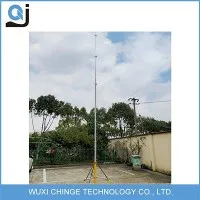
As a leading supplier of winch up poles, I often receive inquiries from customers about how to calculate the power consumption of a winch when winching up a pole. Understanding the power consumption is crucial for efficient operation, cost - control, and ensuring that the winch system is appropriately sized for the task at hand. In this blog, I will walk you through the steps to calculate the power consumption of a winch during the process of winching up a pole.
1. Basic Concepts
Before diving into the calculations, it's important to understand some basic concepts. Power is the rate at which work is done, and it is measured in watts (W). Work, on the other hand, is the force applied over a distance and is measured in joules (J). In the context of a winch, the work is done against gravity to lift the pole to a certain height.
The formula for power is (P=\frac{W}{t}), where (P) is power, (W) is work, and (t) is time. The work done in lifting an object against gravity is given by (W = mgh), where (m) is the mass of the object, (g) is the acceleration due to gravity ((g = 9.81m/s^{2})), and (h) is the height to which the object is lifted.
2. Determine the Mass of the Pole
The first step in calculating the power consumption is to determine the mass of the pole. This can be done in several ways. If the pole is made of a homogeneous material, you can calculate its mass based on its volume and density. The density of common materials such as steel is well - known. For example, the density of steel is approximately (7850kg/m^{3}).
If you know the dimensions of the pole, you can calculate its volume. For a cylindrical pole with radius (r) and length (L), the volume (V=\pi r^{2}L). Then, the mass (m=\rho V), where (\rho) is the density of the material.
In some cases, the manufacturer of the pole may provide the mass directly. If you are using our 30ft Telescopic Winch Up Mast, the product specifications will include the mass information, which simplifies this step.
3. Calculate the Work Done
Once you have determined the mass of the pole, you can calculate the work done in lifting it. As mentioned earlier, the work (W = mgh). Suppose you want to lift the pole to a height (h). For example, if you are using a Manual Telescoping Mast and you want to extend it to its maximum height, that height value will be used in the formula.
Let's assume the mass of the pole (m = 100kg) and you want to lift it to a height (h = 5m). Then the work done (W=mgh=100\times9.81\times5 = 4905J).
4. Determine the Time Taken
The next step is to determine the time (t) it takes to lift the pole. This can vary depending on the speed of the winch. If the winch has a specified lifting speed (v), and you know the height (h) to which the pole is to be lifted, then (t=\frac{h}{v}).
For example, if the winch has a lifting speed of (v = 0.5m/s) and you want to lift the pole to a height (h = 5m), then (t=\frac{h}{v}=\frac{5}{0.5}=10s).


5. Calculate the Power
Now that you have calculated the work done (W) and determined the time (t), you can calculate the power (P) using the formula (P=\frac{W}{t}). Using the values from our previous examples ((W = 4905J) and (t = 10s)), we get (P=\frac{4905}{10}=490.5W).
6. Account for Efficiency
In real - world scenarios, winches are not 100% efficient. There are losses due to friction in the gears, bearings, and other mechanical components. The efficiency (\eta) of a winch is the ratio of the useful power output to the power input.
The actual power consumption (P_{actual}) of the winch can be calculated using the formula (P_{actual}=\frac{P}{\eta}). Winch efficiencies typically range from 60% to 90%. Let's assume an efficiency (\eta = 0.8). Then (P_{actual}=\frac{490.5}{0.8}=613.125W).
7. Consider Other Factors
- Dynamic Forces: When the winch starts and stops, there are additional dynamic forces at play. These forces can increase the power requirements, especially if the winch accelerates or decelerates rapidly. A more detailed analysis using Newton's second law ((F = ma)) may be required to account for these dynamic effects.
- Friction in the Rope or Cable: The friction between the rope or cable and the winch drum, as well as any pulleys in the system, can also increase the power consumption. Lubrication and proper maintenance can help reduce these frictional losses.
8. Using Our Products
At our company, we offer a wide range of winch up poles, including Mechanical Telescopic Mast. Our products are designed with efficiency in mind, and we provide detailed product specifications to help you with your power consumption calculations.
If you are unsure about how to calculate the power consumption for a specific application or have any questions about our winch up poles, our team of experts is here to assist you. We can provide you with accurate data and guidance to ensure that you select the right winch and pole combination for your needs.
Conclusion
Calculating the power consumption of a winch when winching up a pole is a multi - step process that involves determining the mass of the pole, calculating the work done, determining the time taken, and accounting for efficiency. By following the steps outlined in this blog, you can make informed decisions about the power requirements of your winch system.
If you are in the market for high - quality winch up poles, we invite you to explore our product range. Our products are built to last and are suitable for a variety of applications. Contact us today to start a procurement discussion and find the perfect solution for your needs.
References
- Halliday, D., Resnick, R., & Walker, J. (2013). Fundamentals of Physics. Wiley.
- Meriam, J. L., & Kraige, L. G. (2012). Engineering Mechanics: Dynamics. Wiley.