




As a supplier of push up antenna masts, one of the most frequently asked questions I encounter is about the wind resistance of these masts. Wind resistance is a crucial factor when it comes to the performance and durability of an antenna mast, especially in areas prone to high winds or severe weather conditions. In this blog post, I will delve into the concept of wind resistance in push up antenna masts, exploring the factors that influence it and how we, as a supplier, ensure our masts can withstand various wind forces.
Understanding Wind Resistance
Wind resistance, also known as aerodynamic drag, is the force exerted by the wind on an object as it moves through the air. In the context of a push up antenna mast, wind resistance can cause the mast to bend, sway, or even break if it exceeds the mast's structural limits. The wind resistance of a mast is influenced by several factors, including its shape, size, material, and the speed and direction of the wind.
The shape of the mast plays a significant role in determining its wind resistance. A mast with a streamlined shape, such as a circular or oval cross - section, will generally experience less wind resistance compared to a mast with a square or rectangular cross - section. This is because the streamlined shape allows the wind to flow more smoothly around the mast, reducing the drag force.
The size of the mast also affects its wind resistance. A taller and wider mast will have a larger surface area exposed to the wind, resulting in a greater wind force acting on it. Therefore, taller masts typically require stronger construction materials and more robust design to withstand the increased wind loads.
The material used to construct the mast is another important factor. Different materials have different strength - to - weight ratios and resistance to environmental factors. For example, aluminum is a popular choice for push up antenna masts due to its relatively high strength, low weight, and corrosion resistance. Steel, on the other hand, is stronger but heavier, and may be more suitable for masts that need to withstand extremely high winds.
Calculating Wind Resistance
Calculating the exact wind resistance of a push up antenna mast is a complex process that involves fluid dynamics and engineering principles. However, a simplified way to estimate the wind force acting on a mast is by using the following formula:
[F = 0.5\times\rho\times v^{2}\times C_{d}\times A]
where:
- (F) is the wind force (in Newtons)
- (\rho) is the air density (approximately (1.225\ kg/m^{3}) at sea level and (15^{\circ}C))
- (v) is the wind speed (in m/s)
- (C_{d}) is the drag coefficient, which depends on the shape of the mast
- (A) is the projected area of the mast perpendicular to the wind direction
For example, if we have a push up antenna mast with a circular cross - section, a height of (10) meters, and a diameter of (0.1) meters, and the wind speed is (20) m/s ((72) km/h), and the drag coefficient (C_{d}) for a circular cylinder is approximately (0.3).
First, we calculate the projected area (A). The projected area of a cylinder is (A = h\times d), where (h) is the height and (d) is the diameter. So, (A=10\times0.1 = 1\ m^{2}).

Using the formula (F = 0.5\times\rho\times v^{2}\times C_{d}\times A), with (\rho = 1.225\ kg/m^{3}), (v = 20\ m/s), (C_{d}=0.3), and (A = 1\ m^{2})
[F=0.5\times1.225\times20^{2}\times0.3\times1]
[F = 0.5\times1.225\times400\times0.3\times1]
[F=73.5\ N]
Our Approach as a Supplier
At our company, we take wind resistance very seriously when designing and manufacturing push up antenna masts. We use advanced engineering software to simulate the wind loads on our masts under different wind conditions. This allows us to optimize the shape, size, and material of the mast to ensure it can withstand the expected wind forces.
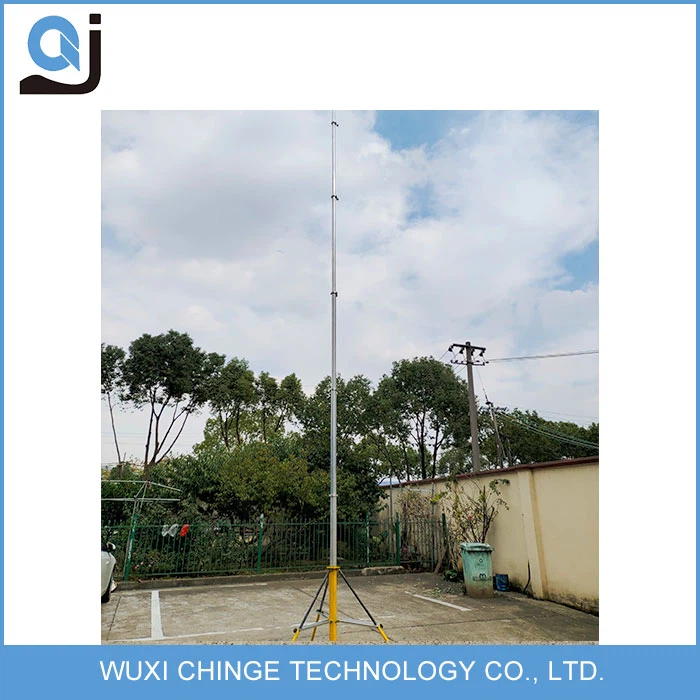
We offer a variety of push up antenna masts, including the Telescoping Mast for Antenna, 25 ft Telescoping Antenna Mast, and Electric Telescoping Mast. Each of these masts is designed with wind resistance in mind.
For example, our telescoping masts are made of high - strength aluminum alloy, which provides a good balance between strength and weight. The circular cross - section of the mast segments reduces the wind drag, and the telescoping design allows for easy adjustment of the mast height, which can be useful in reducing the wind load during high - wind events.
We also conduct rigorous testing on our masts in a wind tunnel to verify their wind resistance performance. This testing helps us to identify any potential weaknesses in the design and make necessary improvements before the masts are released to the market.
Importance of Wind Resistance in Different Applications
The wind resistance of a push up antenna mast is crucial in various applications. In telecommunications, reliable antenna performance is essential for maintaining clear communication signals. A mast that cannot withstand high winds may break or become misaligned, leading to signal loss or interference.
In the field of weather monitoring, antenna masts are often used to support weather sensors and communication equipment. These masts need to be able to withstand the strong winds associated with severe weather conditions, such as hurricanes or thunderstorms, to ensure continuous data collection and transmission.
In military applications, antenna masts are used for communication and surveillance purposes. They need to be robust and reliable, even in harsh and unpredictable environments. High wind resistance is necessary to ensure that the masts can function properly during military operations.
Conclusion
In conclusion, wind resistance is a vital consideration when it comes to push up antenna masts. Understanding the factors that influence wind resistance, such as shape, size, and material, is essential for designing and manufacturing masts that can withstand various wind conditions.
As a supplier, we are committed to providing high - quality push up antenna masts with excellent wind resistance. Our range of products, including the Telescoping Mast for Antenna, 25 ft Telescoping Antenna Mast, and Electric Telescoping Mast, are designed and tested to meet the highest standards of wind resistance.
If you are in the market for a push up antenna mast and need a reliable solution that can withstand the wind, we invite you to contact us for more information and to discuss your specific requirements. Our team of experts is ready to assist you in selecting the right mast for your application.
References
- Anderson, J. D. (2017). Fundamentals of Aerodynamics. McGraw - Hill Education.
- Blevins, R. D. (1990). Applied Fluid Dynamics Handbook. Van Nostrand Reinhold.