


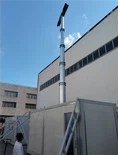

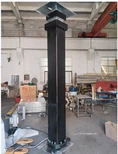
The basic movement is similar across different mast designs, but the lifting method can be manual, winch-operated, hydraulic or motorized.
How Does a Telescopic Mast Extend?
When a telescopic mast is deployed, the lifting system applies force to the mast sections and raises them progressively.
The general process is:
The mast is positioned on its vehicle, trailer or mounting base.
The lifting mechanism is engaged.
The lower or inner mast sections begin to move upward.
Each section extends from the nested position.
The sections reach their designed working positions and are secured.
The mounted equipment is then held at the required operating height.
The exact sequence depends on the mast design. A winch-up telescopic mast, for example, uses a cable and pulley arrangement to raise the sections, while a hydraulic telescopic mast uses hydraulic cylinders to generate the lifting force.
How Does a Telescopic Mast Retract?
Retraction is essentially the reverse process.
After the equipment has completed its operation, the mast is lowered section by section. The sections slide back into one another until the mast reaches its compact transport position.
Before retraction, the equipment and surrounding area should be checked to ensure that nothing interferes with the descending mast. For larger mobile systems, the mast may also need to be returned to a specified transport position before the vehicle or trailer is moved.
Different Ways to Extend a Telescopic Mast
Manual Telescopic Mast
A manual telescopic mast relies on the operator to extend and secure the mast sections. This design is suitable when the mast is relatively light and frequent powered deployment is not required.
Its simple mechanism can be useful for portable antenna, lighting and other lightweight equipment.
Winch-Up Telescopic Mast
A winch-up telescopic mast uses a winch, cable and pulley system to raise the mast sections.
The operator turns the winch to apply tension to the cable. As the cable moves through the lifting system, the nested sections are raised to the required height.
Depending on the design, the winch can be manually operated or powered.
Hydraulic Telescopic Mast
A hydraulic telescopic mast uses hydraulic cylinders to extend the mast.
When hydraulic pressure is supplied to the cylinder, the cylinder produces the force required to move the mast sections. Reversing the hydraulic operation allows the mast to retract.
Hydraulic lifting is commonly used when the mast or its payload is too heavy for convenient manual operation.
Motorized Telescopic Mast
A motorized telescopic mast uses an electric motor to drive the extension mechanism. Depending on the design, the motor may operate a screw drive, cable system or other mechanical transmission.
Motorized operation allows the mast to be raised and lowered with less manual effort and is useful when repeated deployment is required.
What Keeps the Mast Sections in Position?
Extending a mast is only part of the design. The sections also need to remain properly positioned while the mast is supporting equipment.
Depending on the mast construction, positioning can involve:
Mechanical locking mechanisms
Cable and pulley systems
Hydraulic cylinders
Internal or external guides
Section stops and supports
The locking and guidance arrangement needs to match the mast height, payload and operating conditions.
Does Payload Affect Extension and Retraction?
Yes. The payload of a telescopic mast directly affects the force required from the lifting mechanism.
A mast carrying a lightweight antenna may require a relatively small lifting system. A mobile communication mast carrying several antennas or other equipment requires considerably more lifting capacity.
Payload also affects the structural loads on the extended mast, particularly when wind acts on the mounted equipment. Therefore, the lifting mechanism, mast sections and stabilization system should be selected as a complete system.
What Happens When the Mast Is Fully Retracted?
When fully retracted, the mast sections are nested together, significantly reducing the overall transport height.
This is one of the main advantages of a portable telescopic mast. A system can be raised for operation and lowered when it needs to be transported between sites.
For trailer-mounted communication systems, this allows the tower to remain within a practical transport configuration while providing additional height when deployed.
What Should Be Checked Before Extending or Retracting a Mast?
Before operating a telescopic mast, check:
The mast mounting or trailer is properly positioned.
The surrounding area is clear of obstacles.
The mounted equipment is correctly secured.
The lifting mechanism is in normal operating condition.
Cables, pulleys or hydraulic components show no obvious damage.
Ground and stabilization conditions are suitable.
Weather and wind conditions are within the system's operating limits.
These checks are particularly important for taller masts and systems carrying communication equipment.
Telescopic Mast Extension and Retraction for Mobile Applications
For a mobile communication mast, extension and retraction are central to the whole deployment process.
The mast remains compact during transportation. At the destination, the trailer or vehicle is positioned and stabilized, the mast is extended to its working height, and antennas or other equipment can operate at the elevated position.
After the temporary coverage, surveillance or event operation is completed, the mast is lowered and returned to its transport configuration.
This makes telescopic technology suitable for Cell On Wheels (COW), portable communication towers, temporary network coverage and mobile surveillance systems.
Conclusion
A telescopic mast extends by raising its nested sections through a mechanical, winch, hydraulic or motorized lifting system. Retraction lowers those sections back into the nested position.
The correct extension system depends on the mast height, payload, deployment frequency, mounting method and operating environment. For a mobile or temporary communication system, the ability to extend during operation and retract for transportation is one of the main reasons to use a telescopic mast.