


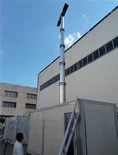

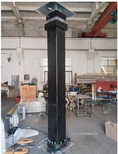
Choosing between them depends mainly on the required height, payload, deployment frequency, mobility and site conditions.
1. Manual Telescopic Mast
A manual telescopic mast is extended by hand and secured at the required height using a mechanical locking system.
This is a relatively simple solution for lightweight equipment such as small antennas, cameras, sensors and portable communication equipment.
Manual masts are most suitable when:
The payload is relatively light
The mast is deployed occasionally
Simple operation is preferred
No hydraulic or electrical power source is available
2. Winch-Up Telescopic Mast
A winch-up telescopic mast uses a winch, cable and pulley mechanism to raise and lower the mast sections.
Compared with a manually lifted mast, the winch reduces the physical effort required to reach the operating height. Depending on the design, the winch can be hand-operated or powered.
Winch-operated masts are commonly used for portable communication, lighting, surveillance and antenna applications.
3. Hydraulic Telescopic Mast
A hydraulic telescopic mast uses hydraulic cylinders to extend and retract the mast sections.
Hydraulic lifting provides a controlled method of raising heavier masts and payloads. It is particularly useful for mobile communication systems and trailer-mounted towers where the mast may need to carry multiple antennas or other equipment.
A hydraulic system is generally selected when the mast requires greater lifting force or frequent powered deployment.
4. Motorized Telescopic Mast
A motorized telescopic mast uses an electric motor to drive the extension mechanism.
Depending on the design, the motor can operate a screw drive, cable mechanism or other transmission system. The operator can raise or lower the mast without manually lifting the individual sections.
Motorized masts are suitable for applications where convenient operation and repeated deployment are important.
5. Vehicle-Mounted Telescopic Mast
A vehicle-mounted telescopic mast is installed directly on a vehicle.
The vehicle provides transportation between sites, while the mast provides temporary elevation for antennas, cameras, lighting or communication equipment.
This configuration is useful for:
Mobile communication
Emergency response
Temporary surveillance
Field monitoring
Remote-site operations
The vehicle-mounted design is especially useful when the mast needs to move frequently between operating locations.
6. Trailer-Mounted Telescopic Mast
A trailer-mounted telescopic mast is integrated into a towable trailer. The complete system can be transported by a suitable vehicle and deployed after reaching the required location.
This configuration is widely used for mobile communication towers, Cell On Wheels (COW), temporary network coverage and event communication systems.
The trailer can also accommodate supporting equipment, depending on the system configuration.
7. Portable Telescopic Mast
A portable telescopic mast is designed for applications where transportation and rapid deployment are important.
Portable designs can be used for temporary antennas, wireless communication equipment, surveillance cameras, lighting and other field equipment.
The key consideration is not simply how small the mast becomes when retracted, but whether its transport dimensions, working height and payload capacity fit the actual application.
How Do These Telescopic Mast Types Differ?
The main differences can be summarized as follows:
| Mast Type | Main Lifting Method | Typical Application |
|---|---|---|
| Manual Telescopic Mast | Manual operation | Lightweight equipment |
| Winch-Up Mast | Winch and cable | Portable communication, lighting, surveillance |
| Hydraulic Telescopic Mast | Hydraulic cylinder | Heavy-duty mobile systems |
| Motorized Telescopic Mast | Electric motor | Frequent powered deployment |
| Vehicle-Mounted Mast | Vehicle-based system | Mobile field operations |
| Trailer-Mounted Mast | Trailer-based system | Temporary communication and network coverage |
| Portable Telescopic Mast | Depends on design | Temporary and remote applications |
These categories can also overlap. For example, a trailer-mounted mast may use a hydraulic lifting system, while a vehicle-mounted mast may use a motorized or winch-operated mechanism.
How to Choose the Right Type of Telescopic Mast?
The lifting method should be selected together with the installation configuration.
Start with the following questions:
What height is required?
A taller mast normally requires a more capable lifting and stabilization system.
What equipment will be mounted?
The weight and exposed area of antennas, cameras, lights or other equipment affect the required payload capacity.
How often will the mast be deployed?
Occasional field use may suit manual or winch operation, while frequent deployment can justify a hydraulic or motorized system.
Does the mast need to move between sites?
Vehicle-mounted and trailer-mounted configurations are more suitable for mobile applications.
What are the site conditions?
Wind speed, ground conditions, available space and stabilization requirements should be considered before selecting the mast.
Conclusion
The main types of telescopic masts differ primarily in their lifting mechanism and installation configuration. Manual and winch-up designs provide relatively simple deployment, while hydraulic and motorized systems are suited to applications requiring powered operation. Vehicle-mounted and trailer-mounted configurations add mobility for temporary and field applications.
For a specific project, the right telescopic mast should be selected according to working height, payload, wind conditions, lifting method, mounting configuration and deployment requirements, rather than choosing a mast based on height alone.