


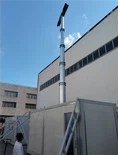

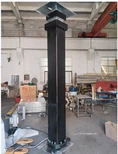
When customers contact us at Wuxi Qinge Technology Co., Ltd., this is usually one of the first direct questions we hear: "What is the price of a telescoping mast for antenna?"
It's a fair question, but over the years we've learned that the answer is rarely just a number. In real projects, the cost is shaped by how the mast will be used, where it will be deployed, and what kind of communication system it needs to support.
We've seen cases where two customers asked for "the same mast," but the final configurations were completely different once we looked at their actual application. One was supporting a short-term event setup in a relatively controlled environment. The other was deployed in a remote industrial zone with strong wind exposure and limited maintenance access. Naturally, the budgets ended up quite different-not because of pricing strategy, but because the engineering requirements were not the same.
Why there is no single price for a telescoping antenna mast
A telescoping mast is not a standard off-the-shelf product in most real applications. It is usually part of a system, and that system determines the cost.
In general, pricing is influenced by:
Mast height and section design
Material (aluminum, steel, hybrid structures)
Load capacity and antenna configuration
Extension mechanism (manual, pneumatic, hydraulic)
Wind resistance rating and structural reinforcement
Mounting platform (fixed base, trailer, vehicle-mounted system)
Even small changes in these factors can shift the cost significantly.
For example, increasing mast height doesn't just add material cost-it also increases structural requirements, which affects stability design and base reinforcement.
What we see in real projects
To make this more practical, let me share how this plays out in real situations.
One client from a remote monitoring project initially requested a basic mast system for temporary deployment. The goal was simple: elevate an antenna for short-term communication coverage. That setup stayed relatively standard in configuration, focusing on ease of transport and quick installation.
Another client working in a coastal industrial area had a very different requirement. The mast needed to handle stronger wind conditions, support multiple antennas, and remain stable over longer continuous operation periods. Even though the application sounds similar on paper, the engineering configuration-and therefore cost-was significantly higher.
In both cases, the "mast" served the same purpose, but the operational environment changed the entire design logic.
Typical cost structure
Instead of thinking in terms of a fixed product price, it's more accurate to break telescoping mast cost into components:
1. Basic mast structure
This includes the telescoping sections, material, and mechanical design. It is the foundation of the system.
2. Lifting mechanism
Manual systems are generally more economical, while pneumatic or hydraulic systems add convenience, speed, and higher cost.
3. Stability and wind resistance design
Reinforcements, guy wires, and base structures are added depending on deployment conditions.
4. Mounting platform
Trailer-mounted systems, vehicle integration, or fixed base structures each affect total cost differently.
5. System integration
Some clients only need the mast. Others require full integration with antennas, power systems, and communication equipment.
Budget planning: what customers often underestimate
From our experience, the mast itself is only part of the total deployment budget.
Many customers initially focus only on equipment cost, but in real-world use, other factors also matter:
Transport and logistics
Setup time and manpower
Power supply configuration
Maintenance and relocation requirements
We've seen projects where optimizing deployment efficiency reduced overall operating costs more than choosing a lower-cost mast.
For example, one field deployment client realized that reducing setup time by even a few hours per site significantly lowered labor and downtime costs over the project cycle.
Cost vs long-term value
It's easy to compare telescoping mast options by upfront price. But in practice, the better question is: what does this system cost over its entire usage cycle?
A lower-cost mast that requires frequent maintenance, limited stability in wind, or longer setup time may end up costing more in real operation. On the other hand, a slightly higher initial investment can improve reliability and reduce operational disruption.
We've seen both scenarios in real deployments, and the difference usually becomes clear only after the system is in the field.
Final thoughts from our experience
At Wuxi Qinge Technology Co., Ltd., we don't treat telescoping mast pricing as a fixed catalogue number. Instead, we look at it as a configuration outcome based on real application needs.
If there is one consistent lesson from our projects, it is this:
the most cost-effective solution is the one that matches the deployment scenario-not the one with the lowest initial price.
If you are evaluating a telescoping mast for antenna, the most useful starting point is to define:
Where it will be used
How often it will be deployed or moved
What equipment it needs to support
What environmental conditions it will face
Once those factors are clear, the cost becomes much more predictable-and the configuration becomes far easier to optimize.
If you want, you can share your project requirements with us. We're always open to helping clients build realistic budgets based on actual deployment conditions rather than theoretical configurations.