


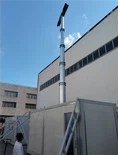

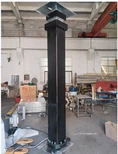
We learned this the hard way: a client needed emergency coverage after a landslide cut access to a fixed tower site. The permanent structure was fine-but the road to it wasn't. We deployed a 22-meter telescoping mast from a nearby highway. It was live in 26 minutes. The fixed tower? Still inaccessible three days later.
That's the thing about telescoping masts: they don't wait for perfect conditions. They show up when the plan breaks, when the timeline compresses, or when "permanent" isn't an option yet.
At Wuxi Qinge Technology, we've helped emergency teams, defense contractors, and remote operators choose between telescoping masts and fixed structures for over a decade. This isn't a feature comparison chart. It's a field-tested guide to when a telescoping mast actually delivers more value-and when a fixed tower still makes sense.
The Real Difference Isn't Height. It's Time.
Fixed structures are engineered for longevity. Telescoping masts are engineered for immediacy.
| Factor | Fixed Tower | Telescoping Mast |
| Deployment time | Weeks to months | 20–45 minutes |
| Relocation | Not feasible without demolition/rebuild | Towable; redeploy in new location in <1 hour |
| Permitting complexity | High | Low |
| Upfront cost | Higher | Lower |
| Flexibility | Optimized for one location, one purpose | Adaptable to evolving coverage needs |
But numbers don't tell the whole story. Let's talk about what actually matters in the field.
Benefit 1: Rapid Deployment - When "Tomorrow" Is Too Late
The Scenario
Disaster response. Major event. Temporary military post. Remote industrial startup. In all these cases, connectivity can't wait for concrete to cure.
Why Fixed Structures Struggle Here
- Permitting alone can take 4–12 weeks in many jurisdictions
- Foundation work requires heavy equipment and stable ground
- Weather delays cascade: rain postpones pouring, which delays erection, which pushes commissioning
How Telescoping Masts Solve It
✅ No foundation required: Outriggers, ballast plates, or ground anchors distribute load on existing surfaces
✅ Minimal site prep: Level ground is ideal, but not mandatory-adaptive base kits handle moderate slopes
✅ Integrated systems: Power, backhaul, and shelter can share the same trailer platform
✅ Trained crew efficiency: 3–4 people can deploy a 20m mast in under 30 minutes
Real Field Note
After a typhoon in Southeast Asia, fixed sites were down due to power loss and fiber cuts. We deployed three telescoping masts (18m–24m) to temporary evacuation centers. The fastest went live in 19 minutes from arrival to first data session. The lesson: in emergencies, "good enough now" beats "perfect later."
Benefit 2: Mobility - When the Mission Moves, the Mast Moves With It
The Scenario
Construction phases shift. Event zones reconfigure. Military operations advance. Remote camps relocate. Fixed towers anchor you to one coordinate. Telescoping masts go where you need them.
Why Relocation Matters
- Cost avoidance: No need to build multiple permanent sites for phased projects
- Risk reduction: If a location becomes unsafe or inaccessible, you're not stranded
- Resource optimization: One mast can serve multiple sites over its lifecycle
Real Deployment: Mining Exploration in Northwest China
A mineral exploration project spanned four survey zones over 18 months. Building four permanent towers wasn't ROI-positive. Instead, we supplied two 22m telescoping masts that:
- Deployed in <4 hours per site vs. 3–4 weeks for civil works
- Relocated between zones in a single convoy
- Integrated hybrid power (solar + battery + generator) to reduce fuel logistics
Total cost of ownership was ~45% lower than permanent infrastructure would have been-and coverage moved with the operation.
When Mobility Creates Unexpected Value
- Network testing: Validate 5G handover performance at multiple heights/locations before committing to permanent sites
- Event production: Reposition masts between main stage, camping zones, and exit corridors as crowd patterns shift
- Disaster recovery: Start at an accessible perimeter point, then relocate deeper as roads clear
Benefit 3: Lower Barrier to Entry - When Budget or Timeline Is Tight
The Financial Reality
Fixed towers require significant upfront capital: permitting fees, foundation engineering, crane rental, extended labor. Telescoping masts shift spend from CAPEX to OPEX-often a better fit for temporary or uncertain needs.
Cost Comparison: 22m Coverage Solution
| Cost Component | Fixed Tower | Telescoping Mast |
| Hardware | $45,000 – $75,000 | $38,000 – $62,000 |
| Foundation/civil works | $15,000 – $40,000 | $0 – $2,000 |
| Permitting/legal | $3,000 – $12,000 | $0 – $1,500 |
| Installation labor | $8,000 – $20,000 | $1,200 – $3,500 |
| Total upfront | $71,000 – $147,000 | $39,200 – $69,000 |
Note: Does not include antennas, backhaul, or power systems (similar for both options).
The Hidden Advantage: Phased Investment
With a telescoping mast, you can:
1. Start with core functionality (mast + basic power)
2. Add backhaul, shelter, or monitoring as needs evolve
3. Upgrade or relocate without sunk-cost anxiety
Fixed towers demand full commitment upfront. Telescoping masts let you scale with confidence.
Benefit 4: Flexibility for Testing and Optimization
The Engineering Reality
Before committing to a permanent tower, carriers and integrators need to validate:
- Coverage patterns at different heights
- Interference with neighboring cells
- Backhaul performance with antenna at final operating height
- Crowd behavior impact on capacity planning
Why Telescoping Masts Enable Better Decisions
✅ Height adjustment: Test performance at 15m, 20m, 25m without rebuilding
✅ Repositioning: Move the mast 50–100m to optimize azimuth/tilt based on real-world data
✅ Rapid iteration: Fail fast, learn faster-without permanent construction costs
Real Use Case: 5G SA Rollout Validation
A carrier used a 24m telescoping mast to test standalone 5G handover performance across an urban corridor. By repositioning the mast in 75m increments and adjusting electrical tilt remotely, they identified an interference pattern that would have caused dropped calls in the permanent design. Fixing it in planning saved an estimated $220,000 in post-construction rework.
When Fixed Structures Still Make Sense
Telescoping masts aren't always the answer. Fixed structures are preferable when:
✅ Long-term horizon: Site will be active >5–7 years with stable coverage needs
✅ Maximum height required: >30m with extreme wind ratings where telescoping engineering becomes cost-prohibitive
✅ Permanent power/fiber available: No need for self-contained systems
✅ Aesthetic or zoning constraints: Some communities prefer camouflaged fixed towers over visible temporary structures
✅ Highest possible uptime: Fixed sites with redundant power/backhaul can achieve 99.999% availability; telescoping masts typically target 99.5–99.9% for temporary missions
The rule of thumb: If you're solving for the next 72 hours, 30 days, or uncertain future-lean telescoping. If you're building for the next decade-lean fixed.
Decision Framework: 5 Questions to Clarify Your Choice
1. What's the time horizon for this deployment?
< 90 days → Strong telescoping mast case
90 days–3 years → Evaluate based on relocation likelihood
> 3 years → Fixed structure likely more economical
2. How certain is the location?
Fixed coordinates long-term → Either option works
May relocate or phase → Telescoping advantage
Multiple sites over time → Mast fleet strategy
3. What are the permitting constraints?
Complex zoning/environmental review → Telescoping often exempt as temporary equipment
Streamlined approval process → Fixed structure feasible
4. Who operates and maintains it?
Dedicated tower crew → Fixed structure manageable
General techs or local staff → Telescoping with simplified SOPs
5. What's the cost of downtime vs. the cost of flexibility?
Emergency/defense: redundancy and speed trump lowest cost
Commercial temporary: balance uptime with relocation needs
If you answer "telescoping" to 3+ of these, it's likely the right tool.
What We've Learned at Wuxi Qinge
After hundreds of deployments, here are the patterns that don't show up in spec sheets:
- The first 30 minutes decide the mission. If power, backhaul, and mast aren't stable in that window, the rest of the deployment fights uphill. We now pre-stage "go-kits" with pre-terminated cables, torque wrenches, and alignment tools to compress that window.
- Mobility isn't just about wheels. It's about design choices that enable fast pack-up: quick-disconnect harnesses, tool-less lock verification, ground-level service points. If a tech can't reverse the deployment in rain with gloves on, it's not truly mobile.
- "Temporary" doesn't mean "disposable". We engineer telescoping masts for 3,000+ raise/lower cycles because many "temporary" deployments become semi-permanent. Designing for durability upfront avoids costly mid-life upgrades.
- Document the field, not just the lab. Our deployment guides include photos of "good vs. bad" cable routing, anchor setups, and wind monitoring placement. New techs learn faster when they see real-world examples.
Quick Answers to the Questions Planners Keep Asking
Q: Can a telescoping mast really match the reliability of a fixed tower?
A: For temporary missions (days to months), yes-with the right spec. We design for 99.5–99.9% uptime with redundant locks, internal cable routing, and remote monitoring. For 99.999% permanent availability, fixed structures still lead. Match the tool to the mission.
Q: How much training do crews need to deploy telescoping masts safely?
A: Basic deployment: 4–8 hours of hands-on training. Advanced operations (guy-wire kits, hybrid power integration): 1–2 days. We include on-site commissioning support for first deployments to accelerate team proficiency.
Q: What about wind ratings? Can telescoping masts handle severe weather?
A: Yes-with appropriate spec. Standard models: 30–36 m/s operational. Premium models with guy-wire kits: up to 45 m/s. Critical: derate for your environment (coastal, high-altitude, urban canyon) and validate with dynamic gust testing data.
Q: Do telescoping masts support 5G and advanced antenna systems?
A: Absolutely. The mast is a mechanical platform; RF performance depends on antenna/RRH selection and backhaul capacity. We integrate with all major vendor equipment and validate mounting geometry for multi-band, MIMO, and mmWave configurations.
Q: What happens if we need to relocate the mast frequently?
A: Specify heavy-duty guides, sealed bearings, and quick-disconnect cables. We offer a "High-Mobility Package" with components rated for 50+ deployments/year. Total cost of ownership is often lower than replacing standard-duty components after unplanned failures.
Why We Build Telescoping Masts the Way We Do at Wuxi Qinge
We don't engineer masts to win spec-sheet comparisons. We build them to survive the gap between planning and reality. That means:
- Testing raise/lower cycles to 3,000+ operations before sign-off
- Validating lock engagement under simulated vibration-not just static load
- Writing deployment guides with photos of "good vs. bad" field practices
- Keeping spare parts aligned with real failure modes
- Designing for the technician working in rain, at 2 AM, with gloves on
If you're evaluating telescoping masts vs. fixed structures for emergency response, defense operations, remote industrial use, or network testing, we're happy to share deployment logs, wind test reports, and TCO modeling. No sales script. Just engineering notes from the field.