


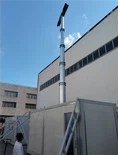

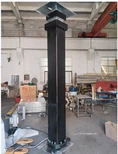
A taller mast also needs to support the required payload and withstand the expected environmental loads when fully extended. Therefore, the maximum working height is normally established during the structural and mechanical design of the complete mast system.
1. Number of Mast Sections
The number of nested sections is one of the main factors affecting the available extension.
More sections can allow a mast to achieve greater height while keeping its retracted dimensions manageable. However, section count alone does not determine the final height.
For example, two masts with the same number of sections can have different extended heights if their individual section lengths are different.
2. Length of Each Section
The length of the individual mast sections directly contributes to the total extended height.
A longer section can provide more extension, but it also affects the retracted length, transportation requirements and structural design.
Manufacturers therefore need to balance section length with the intended mounting configuration and transport dimensions.
3. Section Overlap
Adjacent sections need sufficient overlap when the mast is extended.
This overlap helps maintain guidance and structural connection between the sections. Increasing the overlap can improve the support between sections, but it also reduces the amount of usable extension from each section.
The final mast height therefore depends on both section length and effective extension, rather than the physical length of the sections alone.
4. Mast Diameter
Mast section diameter also influences the maximum practical height.
Telescopic masts generally use progressively smaller sections toward the top. The lower sections carry the loads generated by the upper sections and mounted equipment.
For a taller mast, the manufacturer needs to select appropriate section diameters and wall thicknesses to provide the required stiffness and strength.
A taller mast cannot simply be created by making the existing sections longer without checking the structural consequences.
5. Payload
The required telescopic mast payload can affect the maximum operating height.
A mast supporting a small antenna has different structural requirements from one carrying several antennas, cameras, lights or other communication equipment.
As payload increases, the mast needs to handle greater vertical and lateral loads. The allowable combination of height and payload must therefore be established according to the mast's structural design.
6. Wind Load
Wind is particularly important when determining the maximum extended height.
As the mast becomes taller, the exposed structure and mounted equipment are subjected to wind forces. Antennas, cameras, LED displays and other equipment can also have significant projected areas.
For this reason, a mast may have different allowable payloads or operating conditions at different heights.
The maximum mast height should therefore be considered together with the expected wind speed and mounted equipment.
7. Lifting Mechanism
The lifting mechanism must be capable of extending the mast to its designed height.
Different systems use different methods:
Manual lifting
Winch and cable
Hydraulic cylinder
Electric motor and mechanical drive
The lifting mechanism must provide sufficient force and controlled movement for the weight of the mast sections and payload.
For larger systems, the lifting mechanism becomes an important part of determining the practical mast configuration.
8. Mounting and Stabilization
The way a telescopic mast is installed also affects its usable height.
A mast mounted on a fixed base has different requirements from one installed on a vehicle or trailer. Mobile systems need suitable stabilization to handle the loads generated when the mast is fully extended.
For a trailer-mounted telescopic mast, the trailer chassis, support system and ground conditions all need to be considered together with mast height.
9. Material and Wall Thickness
The material and wall thickness of each section affect the strength and stiffness of the mast.
Steel and aluminum are commonly used for different mast designs, with the appropriate material selected according to the required strength, weight and operating conditions.
Increasing wall thickness can improve structural capacity, but it also increases section weight. This can affect the lifting mechanism and the overall mobile system.
Is a Taller Telescopic Mast Always Better?
No.
The required mast height should be based on the actual application.
For example, a wireless antenna may require sufficient elevation to achieve the desired coverage, while a surveillance camera may need only enough height to obtain the required viewing angle.
Increasing the mast height unnecessarily can increase:
Wind load
Structural requirements
Mast weight
Stabilization requirements
Transportation dimensions
Lifting requirements
Therefore, the goal is to achieve the required working height, not simply the maximum possible height.
How Should Buyers Specify the Required Mast Height?
When requesting a telescopic mast, buyers should provide more than a target height.
Useful project information includes:
- Required extended height
- Maximum retracted height
- Payload weight
- Payload dimensions
- Required wind speed
- Mounting method
- Deployment frequency
- Available power source
- Vehicle or trailer dimensions
- Site and ground conditions
With these parameters, the manufacturer can determine a suitable section configuration and lifting system.
Conclusion
The extended height of a telescopic mast is determined by several interconnected design factors, including number and length of sections, section overlap, diameter, material, payload, wind load and lifting mechanism.
For mobile and temporary communication systems, the design must also balance operating height with retracted dimensions and stabilization requirements.
When selecting a telescopic mast, buyers should therefore specify the required height together with the payload, wind conditions and installation configuration. These details provide a much more useful basis for mast selection than maximum height alone.