




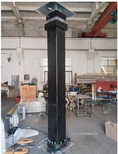
A telescopic mast with a high extended height does not necessarily have a high retracted height. The final collapsed size depends on the mast design and the relationship between its sections.
What Factors Determine the Retracted Height of a Telescopic Mast?
Several design factors directly affect the retracted height.
| Factor | Effect on Retracted Height |
|---|---|
| Number of mast sections | More sections can reduce the length of each section, but increase structural complexity |
| Section length | Longer individual sections generally increase the collapsed height |
| Section overlap | Required overlap between sections affects the minimum collapsed length |
| Mast diameter | Larger sections may influence how sections nest together |
| Extended height | Provides the overall design target but does not directly determine collapsed height |
| Lifting mechanism | Winch, hydraulic, or motorized systems require different mechanical arrangements |
| Base and mounting system | The mast base, pivot, brackets, and platform add to the overall transport height |
| Payload requirements | Heavier payloads can require larger sections and stronger structural components |
1. Number of Telescopic Sections
The number of sections is one of the most important design variables.
For example, a mast designed with several shorter sections may achieve a relatively compact retracted length compared with a mast using fewer but longer sections. However, adding sections does not automatically produce a shorter mast because every section must maintain sufficient structural engagement and mechanical clearance.
For this reason, the section count needs to be considered together with the required extended height, payload, wind load, and structural diameter.
2. Length of Each Section
The individual section length has a direct effect on the collapsed size.
When a telescopic mast is retracted, the smaller sections slide or nest inside the larger sections. The part of each section that remains outside the next section contributes to the final retracted height.
A mast made from longer sections will generally require more transport space than one designed with shorter sections, assuming other structural conditions are similar.
3. Required Section Overlap
Sections cannot simply disappear completely inside one another.
A certain amount of overlap is required to maintain structural support when the mast is extended. This overlap also affects how far the sections can retract.
The required overlap depends on factors such as:
Mast diameter
Section length
Wall thickness
Payload
Wind loading
Structural design
Lifting method
Therefore, reducing overlap simply to obtain a shorter retracted height may not be practical because it can affect the mast's stability and load-bearing performance.
4. Mast Diameter and Section Geometry
The diameter of each section determines how the sections fit together.
A telescopic antenna mast normally uses progressively smaller sections that fit inside larger sections. The outside diameter, inside diameter, wall thickness, and connection details all influence the nesting arrangement.
For heavy-duty applications, larger diameters and thicker walls may be required to handle higher payloads and wind loads. This can limit how compactly the sections can be arranged.
5. Extended Height and Section Arrangement
Extended height and retracted height are related, but they are not the same specification.
For example, two portable communication towers may both reach 12 m when fully extended but have different retracted dimensions because they use different numbers of sections, section lengths, and mounting arrangements.
This is why buyers should not estimate transport dimensions from the extended height alone. The manufacturer should provide both the extended height and retracted height for the specific mast configuration.
6. Lifting Mechanism
The lifting system can also influence the overall design.
A winch-up telescopic mast may use cables, pulleys, and a manual or electric winch. A hydraulic telescopic mast requires cylinders and hydraulic components, while a motorized telescopic mast may use an electric drive and mechanical transmission system.
These components need to be accommodated within or around the mast assembly and can affect the minimum collapsed dimensions.
7. Base and Mounting Structure
The mast tube itself is not always the highest point during transportation.
A trailer-mounted or vehicle-mounted mast may include:
- Pivot brackets
- Base plates
- Support frames
- Locking mechanisms
- Stabilizing components
- Equipment mounting brackets
As a result, the transport height of a mobile communication mast can be greater than the retracted height of the telescopic tube itself.
This distinction is important when checking whether a mast can fit inside a workshop, container, garage, or transportation route.
Why Is Retracted Height Important?
Retracted height directly affects transportation and deployment logistics.
For a portable telescopic mast, a compact retracted size can make it easier to:
- Transport the mast by road
- Store the mast when not in use
- Load the mast into a container or vehicle
- Move the equipment through restricted access areas
- Reduce overall transport height
- Prepare the mast for rapid deployment
For trailer-mounted communication equipment, the retracted height should also be checked against local road transportation requirements and the dimensions of the towing vehicle.
How Should Buyers Compare Retracted Height?
When comparing different telescopic masts, do not look at retracted height as an isolated number.
A practical comparison should include:
Extended Height + Retracted Height + Payload + Wind Load + Section Count + Mast Diameter + Mounting Method
For example, a 10 m portable telescopic tower with a very compact retracted height may not be suitable for a high-wind application if achieving that compact size requires a structural configuration that does not meet the required payload or wind-load conditions.
The correct design is therefore a balance between transport dimensions and deployed performance.
What Information Should Be Confirmed Before Ordering?
For a custom or project-specific telescopic mast, buyers should ask the manufacturer to confirm:
- Extended mast height
- Retracted mast height
- Overall transport dimensions
- Number of sections
- Section diameters
- Maximum payload
- Allowable wind speed or wind load
- Lifting mechanism
- Base or trailer dimensions
- Total equipment weight
These specifications allow the buyer to check both the mast's operating requirements and its transportation limitations.
Conclusion
The retracted height of a telescopic mast is mainly determined by the number and length of the mast sections, required section overlap, section diameter, structural design, lifting mechanism, and mounting system.
Extended height is only the starting point. A properly designed portable telescopic mast must achieve the required working height and payload while remaining compact enough for transportation, storage, and deployment.
For this reason, buyers should always evaluate extended height and retracted height together, rather than assuming that a taller mast will automatically require a longer transport configuration.