


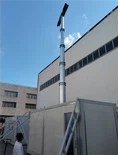

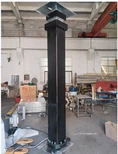
When customers first contact us at Wuxi Qinge Technology Co., Ltd., many of them already have a general idea-they need to "get an antenna higher." But what they're really looking for is not just height, it's a reliable, portable structure that can perform in real-world conditions. That's exactly where a telescoping mast for antenna comes in.
A telescoping mast is essentially a vertically extendable structure made of nested sections that slide or extend upward, one inside another. When collapsed, it's compact enough for transport. When deployed, it reaches the required height to support antennas, communication devices, or surveillance equipment. This ability to transition from compact to elevated-quickly and safely-is what makes it so useful in portable communication systems.
In theory, that sounds straightforward. In practice, how it works depends a lot on the deployment environment and system design.
We once worked with a client setting up a temporary communication link for a remote project site. Their initial thought was simple: bring a mast, extend it, mount the antenna, and start transmitting. But once we discussed the actual conditions-wind exposure, uneven ground, and the need to support multiple devices-it became clear that the mast was not just a "support pole." It was a critical part of the entire communication system.
How the telescoping mechanism works in real use
Most telescoping masts operate through either manual, pneumatic, or hydraulic systems. The principle is similar: each section extends in sequence, locking into place to form a stable vertical structure.
In portable communication setups, speed and simplicity matter. For example, pneumatic masts can be raised quickly using compressed air, which is ideal for rapid deployment scenarios. Manual systems, while slower, are often chosen for their simplicity and lower maintenance in remote environments. Hydraulic systems, on the other hand, offer precise control and higher lifting capacity.
But the lifting mechanism is only part of the story. What really matters is how the mast behaves once it's fully extended.
Stability is just as important as height
A common misconception is that the goal is simply to reach the highest possible point. In reality, stability under load and environmental conditions is what determines whether the system will function reliably.
We've seen cases where a mast technically met the height requirement but struggled when additional antennas or equipment were added. Even small amounts of sway can affect signal alignment, especially for directional communication systems like microwave links.
That's why factors like payload capacity, wind rating, and guying systems are just as important as the extension height itself. In some projects, we've recommended a slightly lower mast with better stability instead of a taller one that would be more sensitive to wind.
How it integrates into portable communication systems
In a typical portable setup, the telescoping mast acts as the elevation platform for communication equipment. It's usually mounted on a trailer, vehicle, or portable base, and works alongside power systems (generators or batteries) and transmission equipment.
The workflow is usually straightforward: transport the system to the site, position and stabilize the base, extend the mast, mount or activate the antennas, and establish the communication link. Depending on the configuration, this process can take anywhere from under an hour to a few hours.
We've worked with clients who needed to repeat this process across multiple locations. For them, consistency and ease of operation were just as important as performance. A mast that is easy to deploy and retract reduces setup time and minimizes the need for highly specialized operators.
Why telescoping masts are preferred in portable scenarios
The main reason telescoping masts are widely used in portable communication systems is their balance between mobility and functionality. Fixed towers offer excellent long-term performance, but they lack flexibility. Telescoping masts fill the gap by providing temporary elevation without permanent installation.
In emergency response, this means restoring communication quickly. In military or field operations, it means maintaining connectivity while moving between locations. In industrial or remote projects, it means having a reliable communication setup without building infrastructure.
At Wuxi Qinge Technology Co., Ltd., we've seen that the success of these systems rarely depends on a single specification. It's usually the result of how well the mast, the equipment, and the deployment conditions work together.
If you're considering a telescoping mast for antenna, it helps to think beyond just "how high it goes." The more relevant question is: How will it perform in your actual working environment? Once that's clear, choosing the right configuration becomes much more straightforward.
If you'd like to discuss your application in more detail, we're always available to share insights based on real deployment experience rather than just theoretical specs.