


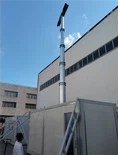

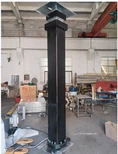
We once raised a telescoping mast at 2 AM in a flooded valley in Southern China. The road was gone. The nearest fixed tower was down. Four people, one trailer, and a 22-meter mast that needed to reach height-reliably-before sunrise.
It went up in 18 minutes. Locked. Antennas aligned. Emergency traffic flowing.
If you've only seen telescoping masts in catalogs, they look like simple poles that extend. In practice, they're precision-engineered platforms that enable connectivity when it matters most: when infrastructure fails, when the mission moves, or when "permanent" isn't an option yet.
At Wuxi Qinge Technology, we've deployed telescoping masts across three continents for emergency response teams, defense contractors, and remote industrial operators. This isn't a theoretical use-case list. It's a field-tested guide to where these systems actually work-and why certain design choices separate "it went up" from "it stayed up."
Emergency Response: When Minutes Matter More Than Permits
The Reality on the Ground
Earthquakes, floods, wildfires, severe storms. When fixed sites lose power, backhaul, or physical integrity, telescoping masts become the fastest path back to connectivity.
What we've learned in the field:
- Speed beats perfection: A 15m mast deployed in 20 minutes often delivers more value than a 30m mast that takes 90 minutes to stabilize
- Backhaul is the silent bottleneck: Everyone focuses on RF and power. But if your satellite terminal can't lock, or your microwave link gets blocked by new debris, the mast is just an expensive pole
- Cable management is a wind-load issue: Loose jumpers act as sails. We route everything internally where possible and use strain-relief clamps at every bend
Real Deployment: Flood Response in Southern China
After heavy rains cut fiber and power to three townships, an emergency management team requested rapid coverage restoration. We deployed two telescoping masts (18m and 22m) to temporary command centers.
Key adaptations that made the difference:
- Guy-wire kits for extra stability in soft, saturated ground
- Pre-terminated cable harnesses to cut RF commissioning time by 60%
- Hybrid power (diesel + battery) to extend runtime during fuel shortages
The masts stayed live for 14 days until permanent infrastructure was restored. The lesson: in emergencies, simplicity and speed beat feature complexity.
When to Spec a Telescoping Mast for Emergency Use
✅ Rapid deployment required (<30 minutes from arrival to live traffic)
✅ Site conditions uncertain or evolving (flood zones, aftershock areas)
✅ Temporary coverage needed (days to weeks, not months)
✅ Mobility matters (may need to relocate as situation changes)
❌ Not ideal for: Long-term recovery (>60 days), permanent infrastructure replacement, or sites with stable grid/fiber already available
Military & Defense: When Reliability Isn't Optional
The Operational Reality
Forward operating bases, border monitoring, temporary command posts, logistics corridors. Military deployments demand connectivity that survives harsh environments, rapid relocation, and adversarial conditions.
What defense contractors tell us they need:
- Rapid setup/teardown: Masts that deploy in <15 minutes and pack equally fast
- Low signature: Minimal visual/RF footprint when operational security matters
- Hardened components: Salt spray, dust, extreme temps, vibration resistance
- Secure integration: Compatibility with encrypted radios, SATCOM, and tactical networks
Real Deployment: Border Monitoring in Northwest China
A defense contractor needed temporary coverage along a 40km remote border segment. Permanent towers weren't feasible due to terrain and permitting. We supplied three 24m telescoping masts with:
- Military-grade quick-disconnect harnesses (rated for 500+ mating cycles)
- Dual-mode backhaul (microwave primary + satellite fallback with auto-failover)
- Low-observable paint options and RF shielding for reduced detection
- Manual override crank points for mast raise/lower in case of power loss
The masts operated for 8 months with quarterly maintenance rotations. Zero downtime due to mast failure.
Critical Design Considerations for Defense Use
| Factor | Why It Matters | Field Adaptation |
| Deployment speed | Mission timelines don't wait for perfect conditions | Pre-staged go-kits with torque wrenches, alignment tools, pre-terminated cables |
| Environmental hardening | Desert dust, coastal salt, Arctic cold accelerate wear | Hot-dip galvanization, sealed connector panels, cold-rated lubricants |
| Maintainability | Field techs may have limited tools or time | Tool-less filter access, color-coded harnesses, ground-level service points |
| Security integration | Encrypted comms require clean RF paths and physical security | Shielded cable runs, lockable shelter options, tamper-evident fasteners |
Remote Operations: When "Permanent" Doesn't Make Sense Yet
The Business Reality
Mining exploration camps, scientific research stations, pipeline monitoring, agricultural operations. Locations where people and equipment need connectivity, but the site may only be active for 6–36 months.
Why building a tower is often overkill:
- Permitting and civil works can take longer than the project lifespan
- ROI on a permanent tower requires 5–10 years of traffic
- Relocation needs: if the site moves, the tower doesn't
Real Deployment: Mineral Exploration in the Gobi Desert
For a 2-year exploration project, a mining company needed reliable comms for telemetry, voice, and limited data. Permanent infrastructure wasn't ROI-positive. We deployed a 22m telescoping mast with:
- Hybrid power system: 4 kW solar array + 20 kWh battery bank + 15 kW diesel generator
- High-gain satellite terminal for backhaul (latency accepted for non-real-time data)
- Dust-sealed shelter with negative-pressure filtration for sensitive electronics
- Remote monitoring dashboard for fuel, temperature, and alarm status
The outcome: Solar offset ~35% of daily consumption, extending generator service intervals from 3 days to 5. When the camp relocated 80 km east, the entire unit moved in one convoy. Total cost of ownership was ~40% lower than a permanent tower would have been for the project duration.
Remote Deployment Checklist (Lessons Learned)
✅ Pre-survey satellite visibility if using VSAT backhaul
✅ Confirm fuel availability and storage safety on-site
✅ Test mast raise/lower in simulated wind conditions before dispatch
✅ Include spare filters, fuses, and connector kits-remote sites don't have hardware stores
✅ Train local staff on basic monitoring (fuel level, alarm status) to reduce dependency on fly-in techs
Secondary Applications: Where Telescoping Masts Add Unexpected Value
Large Events & Temporary Gatherings
Music festivals, sports tournaments, political rallies. One weekend. One location. A surge of devices that would normally be spread across a city-now concentrated in a field.
Why telescoping masts work here:
- Rapid deployment matches event timelines
- Precise height/tilt adjustment shapes coverage to crowd flow, not just blanket an area
- Easy relocation between event phases (main stage → camping zone → exit corridors)
Field note: At a coastal marathon, we positioned two 15m masts at start/finish and one at the mid-point aid station. The trick wasn't power-it was backhaul. Local fiber was saturated by spectator hotspots. We used dual-link backhaul (microwave primary + satellite fallback) for zero dropouts during the 4-hour race window.
Network Testing & Optimization
Carriers use telescoping masts to:
- Test 5G SA handover performance at different heights/tilts before finalizing permanent site plans
- Measure interference patterns in dense urban environments by repositioning the mast in 50m increments
- Validate backhaul options (microwave vs. satellite) with the antenna at final operating height
Because the mast is temporary, teams can iterate faster-and avoid costly mistakes in permanent construction.
Construction & Industrial Sites
Temporary sites where permanent infrastructure won't be ROI-positive for 3–5 years. Telescoping masts bridge the gap until civil works finish.
Key advantage: Deploy in days, not months. No foundation pouring, no tower climbing crews. Relocate as the project phases.
What Actually Fails in the Field
After hundreds of deployments, we stopped chasing the lowest BOM cost and started chasing the lowest downtime. Here's what changed:
| Failure Mode | Why It Happens | Our Design Response |
| Lock mechanism jams | Dust, corrosion, or minor impact misaligns pins | Stainless guide rails + grease-access ports + manual override crank |
| Cable damage during raise/lower | Unsecured jumpers snag on sections | Internal cable channels + strain-relief clamps at every bend |
| Base instability on soft ground | Outriggers sink in mud/sand | Optional ballast plates + wide-footprint base adapters |
| Wind-induced vibration | Resonance at certain heights/wind speeds | Tuned mass dampers on premium models; wind rating tested at 1.5x spec |
| Corrosion in coastal environments | Salt spray attacks joints and fasteners | Hot-dip galvanization + marine-grade hardware + sealed connector panels |
Reliability isn't about over-engineering. It's about knowing which component will fail first-and making the fix take 15 minutes, not 4 hours.
Decision Framework: Is a Telescoping Mast Right for Your Deployment?
Ask these five questions before committing:
1. What's the time horizon?
< 30 days → Strong telescoping mast candidate
30–90 days → Evaluate mast vs. semi-permanent micro-site
> 90 days → Permanent infrastructure likely more economical
2. How certain is the location?
Fixed coordinates → Either option works
May relocate → Telescoping mast advantage
Multiple phased sites → Mast fleet strategy
3. What are the environmental constraints?
High wind, extreme temps, sand, humidity → Specify ruggedized shelter, cooling, and mast options
Limited fuel access → Prioritize hybrid power design
4. Who operates it?
Your own tech team → Standard configuration
Third-party or local staff → Simplified UI, remote diagnostics, clear SOPs
5. What's the cost of downtime vs. the cost of over-specifying?
Emergency/defense: lean toward redundancy
Event coverage: optimize for speed and repositioning
Remote industrial: balance maintainability and fuel efficiency
If you answer "telescoping mast" to 3+ of these, it's likely the right tool.
Why We Build Telescoping Masts the Way We Do at Wuxi Qinge
We don't engineer masts to hit a price point. We build them to survive the gap between planning and reality. That means:
- Testing raise/lower cycles to 3,000+ operations before sign-off
- Validating lock engagement under simulated vibration-not just static load
- Writing deployment guides with photos of "good vs. bad" cable routing, anchor setups, and wind monitoring
- Keeping spare parts aligned with real failure modes
- Designing for the technician working in the rain, at 2 AM, with gloves on
If you're evaluating telescoping masts for emergency response, defense operations, or remote industrial use, we're happy to share deployment logs, wind test reports, and integration checklists. No sales script. Just engineering notes from the field.