


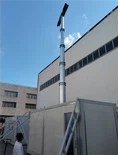

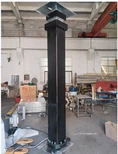
When people first hear about telescopic antenna towers, they often think of them as niche equipment-something only used in highly specialized environments. But in our day-to-day work at Wuxi Qinge Technology Co., Ltd., we've seen just how widely these systems are applied, especially in scenarios where mobility, speed, and adaptability matter more than permanent infrastructure.
Most of our conversations with clients don't start with the product itself. They start with a situation: "We need coverage here, but only for a limited time," or "We can't build a fixed tower in this location." That's usually where telescopic antenna towers come in.
Military and field communication: mobility is everything
One of the most common applications is in military or field-based communication systems. In these environments, the ability to quickly establish a stable communication link can be critical. Fixed towers are not practical when operations are constantly moving or when locations cannot be predetermined.
We've worked with integrators who required towers that could be transported, deployed, and operational within a very short timeframe. In one case, the requirement wasn't just about height-it was about repeatability. The system had to perform reliably across different terrains, from open fields to uneven ground. Telescopic towers provided that balance: compact during transport, but capable of reaching the required elevation when deployed.
Emergency response: when time is the limiting factor
Another area where telescopic antenna towers prove their value is emergency and disaster response. After natural events like floods or storms, communication infrastructure is often one of the first systems to fail-and one of the most important to restore.
We remember a project where a client needed to re-establish temporary communication in a region where the existing network had been disrupted. There was no time for construction, and the ground conditions made it difficult to bring in heavy equipment. A mobile telescopic tower allowed them to restore basic connectivity quickly, buying time until permanent repairs could be made.
In these situations, the question is rarely about long-term performance. It's about how fast you can get a signal back online.
Temporary networks: events, projects, and remote operations
Beyond military and emergency use, telescopic antenna towers are widely used in temporary network setups. This includes large-scale events, construction projects, mining operations, and remote industrial sites.
For example, event organizers often face fluctuating network demand. A location that normally has sufficient coverage can become overloaded when thousands of people gather in one place. Instead of investing in permanent infrastructure, a temporary tower provides additional capacity exactly when and where it's needed.
In industrial scenarios, especially in remote areas, the challenge is often the opposite: there is no existing network at all. We've worked with clients who needed reliable communication for project coordination and safety monitoring in locations far from urban infrastructure. In these cases, telescopic towers act as a bridge, providing connectivity until the project is completed.
Why telescopic towers fit these scenarios so well
Across all these applications, the underlying reason is the same. Telescopic antenna towers are not designed to replace fixed infrastructure-they are designed to fill the gaps where fixed solutions are not practical.
They offer a combination of portability, adjustable height, and relatively simple deployment. That makes them suitable for environments where conditions change, timelines are tight, or permanence is not required.
At Wuxi Qinge Technology Co., Ltd., we've seen that no two projects are exactly alike. Even within the same category-say, emergency response-the requirements can vary significantly depending on terrain, equipment, and operational constraints. That's why we always focus on understanding the real application first, rather than recommending a standard configuration.
If you're considering a telescopic antenna tower, it's worth thinking less about the product itself and more about the scenario you're trying to solve. Is it about speed? Mobility? Temporary coverage? Once that's clear, the right solution becomes much easier to define.
If you'd like to discuss a specific use case or deployment environment, we're always open to sharing practical insights based on real projects.