


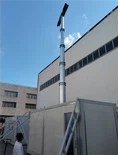

We once raised a telescopic antenna tower in 38 km/h winds on a coastal emergency response site. The crew had 90 minutes before the weather window closed. No crane. No concrete foundation. Just four people, a trailer, and a mast that needed to reach 22 meters-reliably.
It went up in 14 minutes. Locked. Antennas aligned. Traffic flowing.
If you've only seen telescopic towers in brochures, they look simple: a pole that extends. In practice, they're precision-engineered systems that balance height, stability, speed, and survivability. And when mobile communication depends on them-after a disaster, at a remote site, or during a major event-simple isn't enough.
At Wuxi Qinge Technology, we've designed, tested, and deployed telescopic antenna towers across diverse environments. This isn't a textbook definition. It's how they actually work, what matters in the field, and why certain design choices separate "it went up" from "it stayed up."
It's Not Just a "Pole That Goes Up" - Here's What Makes a Telescopic Tower Work
Strip away the marketing, and a telescopic antenna tower is a vertically staged mast system that extends via mechanical, hydraulic, or pneumatic actuation-then locks rigidly at height to support antennas, radios, and backhaul equipment.
But the magic isn't in the extension. It's in the details that keep it stable, safe, and serviceable:
- Nested sections with precision guides: Each stage slides smoothly but locks with zero play under wind load. We machine guide rails to ±0.1mm tolerance-not because the spec demands it, but because vibration kills connections over time.
- Locking mechanisms that don't rely on perfect conditions: Spring-loaded pins, hydraulic locks, or mechanical collars that engage even with dust, moisture, or minor misalignment. If a tech can confirm lock status by feel (not just sight), it's field-ready.
- Integrated cable management: RF jumpers, power lines, and fiber routed internally or along protected channels. No loose cables acting as sails in high wind.
- Base stabilization: Outriggers, ballast plates, or ground anchors that distribute load without requiring poured foundations. Critical for temporary deployments on asphalt, gravel, or uneven terrain.
- Wind-rated engineering: Not just a number on a datasheet. Real-world testing at 1.5x rated load, with dynamic gust simulation. Because weather doesn't read spec sheets.
When we design telescopic towers at Wuxi Qinge, we start with the technician-not the CAD model. How will they raise it with gloves on? Can they inspect locks without disassembly? What happens if power fails mid-raise? Those questions shape the hardware more than any theoretical load calculation.
How It Integrates into Mobile Communication Systems
A telescopic tower doesn't work in isolation. It's one node in a mobile communication ecosystem. Here's how it fits:
1. Antenna Mounting & RF Performance
- Multi-sector antenna arrays (typically 3 x 120° for 4G/5G) mount at the top section
- Remote Radio Heads (RRH) can be mast-mounted (reducing feeder loss) or shelter-mounted (easier maintenance)
- Azimuth and electrical tilt adjustments are accessible at ground level-no climbing required for routine optimization
2. Backhaul Integration
- Microwave dishes or satellite terminals mount on dedicated brackets, aligned independently of the main antenna array
- Fiber entry points include strain relief and drip loops to prevent water ingress
- Redundant backhaul paths (e.g., microwave primary + satellite fallback) are physically separated on the mast to avoid single-point failure
3. Power & Shelter Coordination
- The tower base integrates with a climate-controlled shelter housing BBU, power distribution, and monitoring equipment
- Power cables route through sealed conduits; grounding bonds to the tower base for lightning protection
- Hybrid power systems (generator + battery + solar) can share the same trailer platform for true "one-stop" deployment
4. Remote Monitoring & Control
- Tilt sensors, wind anemometers, and lock-status switches feed telemetry to a central dashboard
- Motorized tilt adjustment (on premium models) allows remote optimization without site visits
- Alarm thresholds trigger SMS/email alerts for wind exceedance, lock failure, or unauthorized movement
The result: a telescopic tower isn't just "antenna height." It's a structured platform that enables rapid, reliable, and maintainable mobile connectivity.
Where Telescopic Towers Actually Shine (Real Deployment Scenarios)
Emergency Response: When Minutes Matter More Than Permits
After an earthquake in Southwest China, fixed sites were down due to power loss and fiber cuts. We deployed two telescopic towers (25m height) to temporary command centers. Key adaptations:
- Guy-wire kits for extra stability in aftershock-prone terrain
- Pre-terminated cable harnesses to cut RF commissioning time by 60%
- Solar-assist power to extend generator runtime during fuel shortages
The towers stayed live for 18 days until permanent infrastructure was restored. The lesson: in emergencies, simplicity and speed beat feature complexity.
Large Events: When Density Beats Coverage
At a multi-day music festival, the challenge wasn't reaching far-it's handling 30,000 devices in 1 km². Telescopic towers offered:
- Precise height adjustment to shape coverage polygons (avoiding interference with neighboring cells)
- Rapid repositioning between event phases (main stage → camping zone → exit corridors)
- Ground-level access for real-time antenna tuning as crowd patterns shifted
Pro tip: For events, we often spec shorter heights (15–18m) with higher-gain antennas. You're optimizing for capacity, not range.
Remote Operations: When "Permanent" Isn't an Option Yet
For a mining exploration camp in Northwest China, permanent towers weren't ROI-positive for a 2-year project. Telescopic towers provided:
- Deployment in <4 hours vs. 3–4 weeks for civil works
- Relocation capability as the camp moved between survey zones
- Hybrid power integration (solar + battery + generator) to reduce fuel logistics
We used a 22m telescopic mast with a guyed option for high-wind seasons. The ability to switch configurations based on weather forecasts saved two potential downtime incidents.
Network Testing & Optimization: When You Need to Validate Before You Commit
Carriers use telescopic towers to:
- Test 5G SA handover performance at different heights/tilts before finalizing permanent site plans
- Measure interference patterns in dense urban environments by repositioning the mast in 50m increments
- Validate backhaul options (microwave vs. satellite) with the antenna at final operating height
Because the tower is temporary, teams can iterate faster-and avoid costly mistakes in permanent construction.
What Actually Fails in the Field (And How We Design Around It)
After years of field feedback, we stopped optimizing for lab specs and started optimizing for field survival. Here's what changed:
| Failure Mode | Why It Happens | Our Design Response |
| Lock mechanism jams | Dust, corrosion, or minor impact misaligns pins | Stainless guide rails + grease-access ports + manual override crank |
| Cable damage during raise/lower | Unsecured jumpers snag on sections | Internal cable channels + strain-relief clamps at every bend |
| Base instability on soft ground | Outriggers sink in mud/sand | Optional ballast plates + wide-footprint base adapters |
| Wind-induced vibration | Resonance at certain heights/wind speeds | Tuned mass dampers on premium models; wind rating tested at 1.5x spec |
| Corrosion in coastal environments | Salt spray attacks joints and fasteners | Hot-dip galvanization + marine-grade hardware + sealed connector panels |
Reliability isn't about over-engineering. It's about knowing which component will fail first-and making the fix take 15 minutes, not 4 hours.
Quick Answers to the Questions Planners Keep Asking
How tall can telescopic towers go?
Standard models: 12–30 meters. Custom designs up to 45m (with guy-wire support). Height selection balances coverage needs, wind load, and transport constraints.
How long does deployment actually take?
4-person crew, flat ground, no guy-wires: 20–40 minutes from arrival to locked height. Add 15–30 minutes if guy-wires or ballast are required.
Can one person operate it?
Technically yes for smaller models (<18m). Practically, we recommend two people: one at controls, one verifying lock engagement and cable clearance. Safety isn't optional.
What about wind ratings?
Standard: 30–36 m/s (110–130 km/h) operational. Premium models: up to 45 m/s with guy-wire kits. Always derate for ice loading or extreme gusts.
Do they work with 5G?
Yes. Telescopic towers support any antenna/RRH that fits the mounting interface. The limiting factor is usually backhaul capacity, not the mast itself.
How do you handle maintenance at height?
Most routine tasks (antenna tilt adjustment, connector inspection) are ground-accessible. For top-section work, we offer optional climb-assist kits-but design to minimize the need.
Why We Build Telescopic Towers the Way We Do at Wuxi Qinge
We don't engineer towers to hit a price point. We build them to survive the gap between planning and reality. That means:
- Testing raise/lower cycles to 3,000+ operations before sign-off (most specs require 500)
- Validating lock engagement under simulated vibration-not just static load
- Writing deployment guides with photos of "good vs. bad" cable routing, anchor setups, and wind monitoring
- Keeping spare parts aligned with real failure modes (e.g., more lock pins, fewer decorative caps)
- Designing for the technician working in rain, at 2 AM, with gloves on
If you're evaluating telescopic towers for emergency response, event coverage, or remote operations, we're happy to share deployment logs, wind test reports, and integration checklists. No sales script. Just engineering notes from the field.
What Is a Telescopic Antenna Tower and How Does It Work in Mobile Communication Systems?
We once raised a telescopic antenna tower in 38 km/h winds on a coastal emergency response site. The crew had 90 minutes before the weather window closed. No crane. No concrete foundation. Just four people, a trailer, and a mast that needed to reach 22 meters-reliably.
It went up in 14 minutes. Locked. Antennas aligned. Traffic flowing.
If you've only seen telescopic towers in brochures, they look simple: a pole that extends. In practice, they're precision-engineered systems that balance height, stability, speed, and survivability. And when mobile communication depends on them-after a disaster, at a remote site, or during a major event-simple isn't enough.
At Wuxi Qinge Technology, we've designed, tested, and deployed telescopic antenna towers across diverse environments. This isn't a textbook definition. It's how they actually work, what matters in the field, and why certain design choices separate "it went up" from "it stayed up."
It's Not Just a "Pole That Goes Up" - Here's What Makes a Telescopic Tower Work
Strip away the marketing, and a telescopic antenna tower is a vertically staged mast system that extends via mechanical, hydraulic, or pneumatic actuation-then locks rigidly at height to support antennas, radios, and backhaul equipment.
But the magic isn't in the extension. It's in the details that keep it stable, safe, and serviceable:
- Nested sections with precision guides: Each stage slides smoothly but locks with zero play under wind load. We machine guide rails to ±0.1mm tolerance-not because the spec demands it, but because vibration kills connections over time.
- Locking mechanisms that don't rely on perfect conditions: Spring-loaded pins, hydraulic locks, or mechanical collars that engage even with dust, moisture, or minor misalignment. If a tech can confirm lock status by feel (not just sight), it's field-ready.
- Integrated cable management: RF jumpers, power lines, and fiber routed internally or along protected channels. No loose cables acting as sails in high wind.
- Base stabilization: Outriggers, ballast plates, or ground anchors that distribute load without requiring poured foundations. Critical for temporary deployments on asphalt, gravel, or uneven terrain.
- Wind-rated engineering: Not just a number on a datasheet. Real-world testing at 1.5x rated load, with dynamic gust simulation. Because weather doesn't read spec sheets.
When we design telescopic towers at Wuxi Qinge, we start with the technician-not the CAD model. How will they raise it with gloves on? Can they inspect locks without disassembly? What happens if power fails mid-raise? Those questions shape the hardware more than any theoretical load calculation.
How It Integrates into Mobile Communication Systems
A telescopic tower doesn't work in isolation. It's one node in a mobile communication ecosystem. Here's how it fits:
1. Antenna Mounting & RF Performance
- Multi-sector antenna arrays (typically 3 x 120° for 4G/5G) mount at the top section
- Remote Radio Heads (RRH) can be mast-mounted (reducing feeder loss) or shelter-mounted (easier maintenance)
- Azimuth and electrical tilt adjustments are accessible at ground level-no climbing required for routine optimization
2. Backhaul Integration
- Microwave dishes or satellite terminals mount on dedicated brackets, aligned independently of the main antenna array
- Fiber entry points include strain relief and drip loops to prevent water ingress
- Redundant backhaul paths (e.g., microwave primary + satellite fallback) are physically separated on the mast to avoid single-point failure
3. Power & Shelter Coordination
- The tower base integrates with a climate-controlled shelter housing BBU, power distribution, and monitoring equipment
- Power cables route through sealed conduits; grounding bonds to the tower base for lightning protection
- Hybrid power systems (generator + battery + solar) can share the same trailer platform for true "one-stop" deployment
4. Remote Monitoring & Control
- Tilt sensors, wind anemometers, and lock-status switches feed telemetry to a central dashboard
- Motorized tilt adjustment (on premium models) allows remote optimization without site visits
- Alarm thresholds trigger SMS/email alerts for wind exceedance, lock failure, or unauthorized movement
The result: a telescopic tower isn't just "antenna height." It's a structured platform that enables rapid, reliable, and maintainable mobile connectivity.
Where Telescopic Towers Actually Shine (Real Deployment Scenarios)
Emergency Response: When Minutes Matter More Than Permits
After an earthquake in Southwest China, fixed sites were down due to power loss and fiber cuts. We deployed two telescopic towers (25m height) to temporary command centers. Key adaptations:
- Guy-wire kits for extra stability in aftershock-prone terrain
- Pre-terminated cable harnesses to cut RF commissioning time by 60%
- Solar-assist power to extend generator runtime during fuel shortages
The towers stayed live for 18 days until permanent infrastructure was restored. The lesson: in emergencies, simplicity and speed beat feature complexity.
Large Events: When Density Beats Coverage
At a multi-day music festival, the challenge wasn't reaching far-it's handling 30,000 devices in 1 km². Telescopic towers offered:
- Precise height adjustment to shape coverage polygons (avoiding interference with neighboring cells)
- Rapid repositioning between event phases (main stage → camping zone → exit corridors)
- Ground-level access for real-time antenna tuning as crowd patterns shifted
Pro tip: For events, we often spec shorter heights (15–18m) with higher-gain antennas. You're optimizing for capacity, not range.
Remote Operations: When "Permanent" Isn't an Option Yet
For a mining exploration camp in Northwest China, permanent towers weren't ROI-positive for a 2-year project. Telescopic towers provided:
- Deployment in <4 hours vs. 3–4 weeks for civil works
- Relocation capability as the camp moved between survey zones
- Hybrid power integration (solar + battery + generator) to reduce fuel logistics
We used a 22m telescopic mast with a guyed option for high-wind seasons. The ability to switch configurations based on weather forecasts saved two potential downtime incidents.
Network Testing & Optimization: When You Need to Validate Before You Commit
Carriers use telescopic towers to:
- Test 5G SA handover performance at different heights/tilts before finalizing permanent site plans
- Measure interference patterns in dense urban environments by repositioning the mast in 50m increments
- Validate backhaul options (microwave vs. satellite) with the antenna at final operating height
Because the tower is temporary, teams can iterate faster-and avoid costly mistakes in permanent construction.
What Actually Fails in the Field (And How We Design Around It)
After years of field feedback, we stopped optimizing for lab specs and started optimizing for field survival. Here's what changed:
| Failure Mode | Why It Happens | Our Design Response |
| Lock mechanism jams | Dust, corrosion, or minor impact misaligns pins | Stainless guide rails + grease-access ports + manual override crank |
| Cable damage during raise/lower | Unsecured jumpers snag on sections | Internal cable channels + strain-relief clamps at every bend |
| Base instability on soft ground | Outriggers sink in mud/sand | Optional ballast plates + wide-footprint base adapters |
| Wind-induced vibration | Resonance at certain heights/wind speeds | Tuned mass dampers on premium models; wind rating tested at 1.5x spec |
| Corrosion in coastal environments | Salt spray attacks joints and fasteners | Hot-dip galvanization + marine-grade hardware + sealed connector panels |
Reliability isn't about over-engineering. It's about knowing which component will fail first-and making the fix take 15 minutes, not 4 hours.
Quick Answers to the Questions Planners Keep Asking
How tall can telescopic towers go?
Standard models: 12–30 meters. Custom designs up to 45m (with guy-wire support). Height selection balances coverage needs, wind load, and transport constraints.
How long does deployment actually take?
4-person crew, flat ground, no guy-wires: 20–40 minutes from arrival to locked height. Add 15–30 minutes if guy-wires or ballast are required.
Can one person operate it?
Technically yes for smaller models (<18m). Practically, we recommend two people: one at controls, one verifying lock engagement and cable clearance. Safety isn't optional.
What about wind ratings?
Standard: 30–36 m/s (110–130 km/h) operational. Premium models: up to 45 m/s with guy-wire kits. Always derate for ice loading or extreme gusts.
Do they work with 5G?
Yes. Telescopic towers support any antenna/RRH that fits the mounting interface. The limiting factor is usually backhaul capacity, not the mast itself.
How do you handle maintenance at height?
Most routine tasks (antenna tilt adjustment, connector inspection) are ground-accessible. For top-section work, we offer optional climb-assist kits-but design to minimize the need.
Why We Build Telescopic Towers the Way We Do at Wuxi Qinge
We don't engineer towers to hit a price point. We build them to survive the gap between planning and reality. That means:
- Testing raise/lower cycles to 3,000+ operations before sign-off
- Validating lock engagement under simulated vibration-not just static load
- Writing deployment guides with photos of "good vs. bad" cable routing, anchor setups, and wind monitoring
- Keeping spare parts aligned with real failure modes
- Designing for the technician working in rain, at 2 AM, with gloves on
If you're evaluating telescopic towers for emergency response, event coverage, or remote operations, we're happy to share deployment logs, wind test reports, and integration checklists. No sales script. Just engineering notes from the field.