


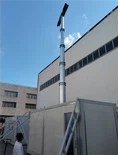

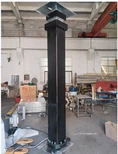
When people first encounter telescoping antenna masts, they often assume they are specialized equipment reserved for telecom operators or defense contractors. In our daily work at Wuxi Qinge Technology Co., Ltd., we've found the reality is broader-and more practical. These systems are used anywhere communication needs to be established quickly, reliably, and without permanent infrastructure.
Most inquiries we receive don't start with a product request. They start with a situation: "We need communication in a place where nothing exists yet," or "We need to restore connectivity after disruption." That's usually where telescoping antenna masts become relevant.
Emergency response: restoring communication when time matters most
One of the most critical applications is emergency communication. After natural disasters such as floods, storms, or earthquakes, existing telecom infrastructure is often damaged or overloaded. In these moments, restoring connectivity becomes a priority for coordination, rescue operations, and public safety.
We've supported projects where deployment conditions were far from ideal-limited road access, unstable ground, and urgent timelines. In one case, a temporary communication setup had to be established shortly after severe weather disrupted local networks. There was no time for construction or complex installation. A mobile telescoping mast system allowed the team to raise antennas quickly and re-establish basic communication links within a very short deployment window.
In these scenarios, the value of the system is not theoretical performance-it is how fast it can bring communication back online.
Military and field operations: mobility and adaptability
Another key application area is military and field-based communication systems. These environments are dynamic by nature. Locations can change, missions can shift, and infrastructure must adapt accordingly.
Fixed towers are not suitable in such contexts because they require permanent installation. Telescoping antenna masts, especially when integrated into mobile platforms, allow communication systems to move with operational units.
We've worked with integrators who required systems capable of repeated deployment across different terrains. In these cases, consistency and reliability were more important than maximum structural complexity. The mast needed to perform the same way whether it was deployed in open terrain or more challenging environments with uneven ground.
The key requirement here is not just height-it is repeatable, reliable deployment under changing conditions.
Remote industrial and infrastructure sites: connecting isolated operations
Beyond emergency and defense use, telescoping antenna masts are widely used in remote industrial environments such as mining sites, energy projects, and large-scale construction zones.
These locations often face a common challenge: there is no existing communication infrastructure, yet coordination and safety depend heavily on connectivity.
We've worked with clients operating in remote areas where even basic communication signals were unavailable. In such cases, a telescoping mast becomes a practical solution for establishing a temporary or semi-permanent communication hub.
One example involved a long-term industrial project in a remote zone where teams needed stable communication for logistics and safety monitoring. Instead of investing in permanent infrastructure that might not be required after project completion, a mobile mast system provided the necessary coverage throughout the project lifecycle.
This approach allowed flexibility without locking into long-term construction commitments.
Temporary networks: events, field operations, and seasonal demand
Telescoping antenna masts are also commonly used in temporary network deployments such as large events, outdoor gatherings, and seasonal operations.
In these scenarios, network demand spikes significantly for a limited period. Permanent infrastructure may not be practical or cost-effective.
We've seen cases where event organizers needed additional network capacity to support thousands of users in a concentrated area. A temporary mast system allowed them to enhance coverage only for the duration of the event, then remove the system once demand returned to normal.
The key advantage here is scalability without permanence.
Why telescoping masts fit these scenarios
Across all these applications-emergency response, military operations, remote industry, and temporary networks-the underlying requirement is the same:
Fast deployment
Mobility
Adaptability to different environments
Temporary or flexible usage cycles
Telescoping antenna masts are not meant to replace fixed communication infrastructure. Instead, they fill the gap where fixed systems are impractical due to time, location, or operational constraints.
Practical perspective from our experience
At Wuxi Qinge Technology Co., Ltd., we've noticed that successful deployments rarely depend on the mast alone. They depend on how well the system matches the real-world conditions it will face.
Two projects may use similar equipment, but if one is deployed in a stable industrial site and another in a rapidly changing emergency environment, the design priorities are completely different.
That's why we always start by understanding the application first-before discussing specifications.
Final thought
If there is one consistent takeaway from real-world deployments, it is this: telescoping antenna masts are most valuable not because of what they are, but because of where and how they are used.
They exist to solve a practical problem-providing communication where traditional infrastructure is too slow, too permanent, or simply not feasible.
If you are evaluating a telescoping antenna mast for your project, the most important question is not the product itself, but the environment it will operate in. Once that is clear, the right configuration becomes much easier to define.
If you want, you can share your scenario with us. We're always open to discussing real deployment conditions and helping translate them into workable technical solutions.