


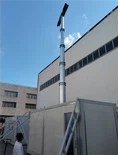

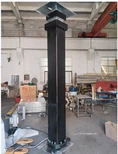
We learned this the hard way: a 26-meter telescoping mast, perfect on paper, deployed for a coastal emergency drill. Wind gusts hit 34 m/s-below its rated 36 m/s spec. The mast held. But the antenna bracket vibrated just enough to loosen an N-connector. Signal dropped. The drill kept going, but the lesson stuck.
Specs don't fail. Assumptions do.
At Wuxi Qinge Technology, we've helped emergency teams, defense contractors, and remote operators select telescoping antenna masts for over a decade. This isn't a generic buyer's guide. It's a field-tested framework for choosing the right mast when height, payload, stability, and wind rating actually matter-because someone's connectivity depends on it.
Start With the Question No Spec Sheet Answers: "What Happens If It Fails?"
Before you compare numbers, ask: what's the cost of downtime?
- Emergency response: Hours matter. Redundancy and rapid repair trump lowest cost.
- Live events: Minutes matter. Stability and interference control are non-negotiable.
- Remote operations: Days matter. Maintainability and fuel efficiency outweigh upfront savings.
Your risk profile shapes your mast choice more than any single specification. Keep that in mind as we walk through the four critical factors.
Factor 1: Height - It's Not "Higher Is Better." It's "Right Height for the Job."
The Trap
Everyone wants maximum coverage. So they spec the tallest mast available. Then they discover:
- Wind load increases exponentially with height (not linearly)
- Transport constraints limit deployable height in urban or forested areas
- Antenna tilt adjustments become harder to optimize from the ground
The Field-Tested Approach
Match height to your actual coverage need-not your aspirational one.
| Scenario | Recommended Height | Why |
| Urban emergency response | 15–18m | Balances coverage with lower wind profile; easier to position between buildings |
| Rural disaster recovery | 22–28m | Clears tree lines and terrain obstacles; guy-wire kits recommended for stability |
| Large outdoor events | 12–18m | Optimizes for capacity density, not range; easier to reposition between zones |
| Remote mining/camp sites | 18–24m | Compromise between coverage and transport logistics; hybrid power integration easier at mid-height |
| Network testing/validation | 15–30m | Flexibility to test performance at multiple heights before finalizing permanent site plans |
Real Deployment Note
For a flood response in Southern China, we initially planned a 30m mast. After site survey, we switched to 22m with a high-gain antenna array. Why? The floodplain was flat-no terrain to clear-and the lower height reduced wind load by ~40%, allowing faster deployment with fewer anchors. Coverage met requirements. Setup time dropped from 55 minutes to 28.
Pro Tip: Always model coverage with real terrain data (not just radius circles). A 22m mast on a hill often outperforms a 30m mast in a valley.
Factor 2: Payload - It's Not Just "How Much Weight." It's "How That Weight Behaves."
The Trap
Buyers focus on maximum payload (kg) but overlook:
- Dynamic load: Wind acting on antennas creates oscillating forces, not just static weight
- Moment arm: A 10kg antenna at 25m height creates far more torque than at 15m
- Asymmetric loading: Uneven antenna placement can induce torsion, stressing guide rails
The Field-Tested Approach
Evaluate payload as a system, not a number.
✅ Ask for moment rating, not just payload
A mast rated for 50kg at 15m may only handle 25kg at 25m. Get the full moment curve.
✅ Specify antenna mounting geometry upfront
Will you use a single top mount? Multi-sector brackets? Microwave dish on a side arm? Share your antenna layout early-we'll validate structural compatibility.
✅ Plan for future upgrades
If you might add 5G mmWave panels or additional backhaul dishes later, spec 20–30% headroom now. Retrofitting payload capacity is expensive; designing for it upfront isn't.
Real Deployment Note
For a 5G trial in a mountainous region, the client wanted to mount four RRHs plus a microwave dish. Standard brackets couldn't handle the asymmetric load. We co-designed a custom top plate with balanced mounting points and reinforced the upper section. Result: zero vibration issues after 6 months of operation.
Pro Tip: Use our free load calculator (link below) to model your antenna configuration before ordering. Better to over-engineer on paper than under-perform in the field.
Factor 3: Stability - It's Not Just "Will It Stand Up." It's "Will It Stay Aligned."
The Trap
"Stable" on flat concrete doesn't mean "stable" on gravel, mud, or a sloped highway shoulder. Base design matters more than most buyers realize.
The Field-Tested Approach
Match base stabilization to your deployment terrain.
| Terrain Type | Recommended Base Solution | Why |
| Paved/flat surfaces | Standard outriggers + ballast plates | Quick setup, adequate for most conditions |
| Gravel/uneven ground | Wide-footprint adapters + adjustable outriggers | Compensates for minor slopes, distributes load |
| Soft/muddy terrain | Ground anchors + sandbag-compatible base | Prevents outrigger sinkage, adds lateral stability |
| High-wind/exposed sites | Guy-wire kit | Reduces mast deflection, improves lock engagement under load |
| Frequent relocation | Quick-release base adapters + integrated transport locks | Speeds pack-up, reduces wear on connection points |
Real Deployment Note
At a coastal marathon, we deployed three 15m masts on a grassy embankment. Standard outriggers started sinking after 90 minutes of foot traffic. We switched to wide-footprint adapters + ground anchors for the remaining units. Zero stability issues for the rest of the event.
Pro Tip: Always carry a simple spirit level and torque wrench. A mast that's 2° off-plumb may look fine-but over time, that tilt amplifies wind load and accelerates wear on locking mechanisms.
Factor 4: Wind Rating - The Number on the Datasheet Isn't the Whole Story
The Trap
"Rated for 36 m/s" sounds solid. Until you learn:
- That rating assumes perfect installation, new components, and no ice loading
- Gusts can exceed sustained wind speeds by 1.5–2x
- Coastal salt spray or desert dust accelerates wear on locking mechanisms
The Field-Tested Approach
Treat wind rating as a starting point, not a guarantee.
✅ Derate for your environment
- Coastal/high-humidity: subtract 5–8 m/s from rated value for long-term reliability
- High-altitude/cold: account for ice loading (adds 20–40% effective wind load)
- Urban canyon: gust turbulence can create localized loads exceeding open-field ratings
✅ Specify the right mast type for wind conditions
| Mast Type | Best For | Wind Adaptation |
| Telescoping | Quick deployment, moderate wind (<30 m/s) | Internal locking, tuned mass dampers on premium models |
| Telescoping + guy-wire kit | High-wind zones, extended height | Anchor kits, tension monitors, quick-release for emergency lowering |
| Hybrid | Permanent-temporary sites, extreme wind | Reinforced lower sections, independent upper-section damping |
✅ Validate with real-world testing data
Ask for test reports that show:
- Dynamic gust simulation (not just static load)
- Lock engagement verification after 1,000+ raise/lower cycles
- Corrosion resistance testing for your target environment
Real Deployment Note
After a typhoon drill, we reviewed telemetry from three masts: one unguyed at 24m, one guyed at 28m, and one hybrid at 30m. All were rated for 36 m/s. During 34 m/s gusts:
- Unguyed: acceptable deflection, but antenna tilt shifted 2° (required remote recalibration)
- Guyed: minimal movement, but anchor inspection needed post-event
- Hybrid: best stability, but 40% longer setup time
The takeaway: wind rating is necessary but insufficient. Match mast type to your risk tolerance and operational timeline.
The Decision Framework: 5 Questions to Ask Before You Commit
1. What's the maximum wind speed at my deployment location-and how often does it exceed 25 m/s?
→ If >10 days/year, prioritize guy-wire compatibility or hybrid design.
2. What's my actual antenna payload-and where will each component mount?
→ Share your antenna layout early. We'll validate moment load and bracket compatibility.
3. How quickly do I need to deploy-and how often will I relocate the mast?
→ Frequent moves favor telescoping-only; long-term temporary sites can benefit from guyed stability.
4. Who will operate it-and what's their training level?
→ Complex systems need skilled techs. If local staff will operate it, prioritize intuitive controls and clear lock indicators.
5. What's the cost of downtime vs. the cost of over-specifying?
→ Emergency response: lean toward redundancy. Event coverage: optimize for speed and repositioning. Remote sites: balance maintainability and fuel efficiency.
If you answer "guyed," "custom bracket," "frequent moves," "minimal training," or "high downtime cost" to any of these, let's talk before you finalize specs.
What We've Learned at Wuxi Qinge
After hundreds of deployments, here are the patterns that don't show up in brochures:
- The first 10 minutes of wind exposure reveal more than 10 hours of lab testing. We now include a "settling period" in deployment checklists: raise to height, wait 10 minutes, re-check all locks and cable strain points before connecting RF.
- Cable management is a wind-load issue, not just an organization issue. Loose jumpers act as sails. We route everything internally where possible, use strain-relief clamps at every bend, and torque connectors to spec before leaving the factory.
- Technician feedback beats theoretical optimization. A lock mechanism that engages with a satisfying "click" (and can be verified by feel) reduces human error more than a "more elegant" design that requires visual confirmation.
- Document the field, not just the lab. Our deployment guides now include photos of "good vs. bad" cable routing, anchor setups, and wind monitoring placement. New techs learn faster when they see real-world examples.
Quick Answers to the Questions Planners Keep Asking
Q: Can I use a telescoping mast in coastal environments?
A: Yes-with adaptations. Specify hot-dip galvanization, marine-grade hardware, and sealed connector panels. Derate wind rating by 5–8 m/s for long-term reliability. We offer a "Coastal Package" with these upgrades pre-integrated.
Q: How do I know if I need guy-wires?
A: Rule of thumb: if height > 20m OR wind rating > 30 m/s OR site is exposed (no windbreaks), plan for guy-wire capability. Even if you don't deploy them initially, having anchor points pre-installed gives you options if weather changes.
Q: What's the real-world difference between 30 m/s and 36 m/s wind rating?
A: In open terrain, ~20% higher gust tolerance. In turbulent environments (urban, mountainous), the practical difference shrinks-gust dynamics matter more than peak rating. Focus on dynamic testing data, not just the number.
Q: Can I upgrade payload capacity later?
A: Partially. You can often reinforce upper sections or add custom brackets, but the base structure and guide rails are fixed at manufacture. If future expansion is likely, spec 20–30% headroom upfront.
Q: How do I validate a mast before full deployment?
A: Request a factory acceptance test (FAT) report with:
- Static load test at 1.5x rated moment
- Dynamic gust simulation (if available)
- Lock engagement verification after 500+ cycles
- Corrosion resistance certification for your environment
We include these as standard for critical deployments.
Ready to Talk Through Your Specific Scenario?
If you're evaluating telescoping masts for emergency response, event coverage, remote operations, or network testing, we're happy to walk through your constraints. No generic brochures. Just engineering notes, load curves, and lessons from the field.