


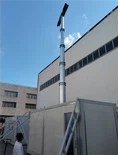

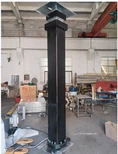
In discussions with customers at Wuxi Qinge Technology Co., Ltd., this comparison comes up very frequently: why choose a telescoping antenna mast instead of a fixed tower?
On paper, fixed towers often look like the "stronger" long-term solution. But in real deployments, especially when timing and flexibility matter, the answer is not that simple. Over the years, we've supported both types of systems, and the choice usually depends on one thing: whether the communication need is permanent or operationally dynamic.
The real difference starts with time
Fixed towers are infrastructure projects. They require planning, engineering design, site preparation, and often regulatory approvals. Even in straightforward cases, the process can take weeks or months before a usable system is in place.
We've seen situations where clients initially planned fixed towers for temporary coverage needs, only to realize the timeline itself made the solution impractical. In one project involving seasonal operations, the communication requirement was urgent but short-lived. By the time a fixed structure would have been completed, the operational window would have already passed.
A telescoping antenna mast changes that equation completely. Instead of waiting for construction, the system can be transported, positioned, and deployed within a much shorter timeframe. In many real-world cases, this difference between "weeks" and "hours or days" is the deciding factor.
Flexibility in changing environments
Another major advantage is adaptability.
Fixed towers are permanent. Once installed, they are tied to a single location. If operational needs shift, additional infrastructure must be built elsewhere.
Telescoping antenna masts, especially when mounted on mobile platforms, can be relocated as required. We've worked with clients in industries where project sites change over time. Instead of rebuilding infrastructure at each location, they reuse the same mobile system across multiple deployments.
One client operating in a multi-site industrial project cycle moved their communication setup several times over the course of a year. The ability to redeploy the same system reduced both cost and logistical complexity.
Practical deployment in real conditions
In controlled environments, fixed towers offer excellent performance and long-term stability. But many real-world projects do not take place in controlled environments.
We've supported deployments in areas with limited access, uneven terrain, and tight operational schedules. In such cases, bringing in construction equipment for a fixed tower is not always feasible.
A telescoping mast, on the other hand, can be deployed with minimal site preparation. This makes it particularly useful in:
Temporary project sites
Remote industrial zones
Emergency communication setups
Events and short-term coverage needs
In one field deployment scenario, the ability to avoid heavy civil work allowed the client to establish communication in a location where fixed infrastructure would have been impractical within the project timeline.
Cost is not just construction-it is usage efficiency
At first glance, fixed towers may appear to be a long-term investment with stable cost distribution over time. However, this only applies when the tower is used continuously over many years.
For temporary or shifting requirements, the economics change. A fixed tower includes not only construction cost but also permitting, land usage, and long-term maintenance-even if the structure is only needed for a short period.
A telescoping antenna mast allows a different approach: pay for usage, not permanence. The system can be deployed when needed and relocated or stored when not in use. We've seen clients significantly improve cost efficiency simply by avoiding unnecessary permanent installations for temporary needs.
Deployment speed and operational simplicity
Another practical difference is how quickly the system becomes operational.
Fixed towers involve multiple stages before activation. Telescoping masts are designed for rapid deployment. Depending on configuration, a system can be set up, raised, and made operational in a relatively short time once on site.
We've worked with teams where deployment efficiency directly impacted project success. In time-sensitive operations, reducing setup complexity also reduces dependency on large technical crews.
When fixed towers still make more sense
It's important to be clear: telescoping antenna masts are not a replacement for fixed towers in every case.
Fixed towers remain the better option when:
Long-term, high-capacity coverage is required
The site is permanent and stable
Maximum structural load and multi-system integration are needed
In such scenarios, permanence and capacity outweigh mobility.
Final perspective from field experience
At Wuxi Qinge Technology Co., Ltd., we've found that the decision is rarely about which system is "better" in general. It is about which system aligns with how communication needs evolve in real operations.
Telescoping antenna masts are preferred not because they are more powerful, but because they are more responsive to change. They fit environments where time is limited, locations shift, or infrastructure permanence is unnecessary.
If there is one question that usually clarifies the decision, it is this:
Is your communication need fixed in place, or does it need to move with your operation?
Once that is answered, the choice between a telescoping mast and a fixed tower becomes much more straightforward.
If you'd like to evaluate a specific scenario, we're always open to sharing practical insights based on real deployment experience.