


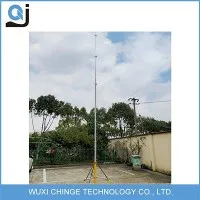
Can a winch be used to winch up a pole on a soft ground? This is a question that often comes up in various industries, especially when dealing with the installation of poles such as antenna masts or utility poles. As a winch up pole supplier, I've encountered this question numerous times, and in this blog, I'll explore the feasibility, challenges, and solutions related to using a winch to raise a pole on soft ground.
Understanding the Basics of Winching Up a Pole
Before delving into the soft - ground scenario, let's first understand the basic principle of using a winch to raise a pole. A winch is a mechanical device that uses a spool and a cable or rope to pull or lift heavy objects. When it comes to raising a pole, the winch is typically attached to the top or a point near the top of the pole, and the other end of the cable is secured to a stable anchor point. As the winch is operated, it pulls the cable, gradually lifting the pole from a horizontal to a vertical position.
Challenges of Winching Up a Pole on Soft Ground
Soft ground presents several unique challenges when using a winch to raise a pole:
Lack of Stability
Soft ground lacks the firmness required to provide a stable base for the winch and the pole during the lifting process. The winch may sink into the ground, causing it to lose its position and potentially fail to lift the pole effectively. Moreover, the pole's base may also sink or shift, leading to an unstable lift and increasing the risk of the pole falling during the operation.
Increased Resistance
The soft ground can create additional resistance as the pole is being lifted. The soil may stick to the pole, making it heavier and more difficult to move. This increased resistance can put extra strain on the winch, potentially causing it to overheat or even break down.
Difficulty in Anchoring
Anchoring the winch and the pole securely is crucial for a successful lift. However, on soft ground, it can be extremely difficult to find a suitable anchor point. Traditional anchoring methods, such as using stakes or concrete blocks, may not work well as they can easily be pulled out or sink into the ground.
Solutions to Overcome Soft - Ground Challenges
Ground Stabilization
One of the most effective ways to deal with soft ground is to stabilize it. This can be done by laying a large, flat plate or a mat under the winch and the base of the pole. The plate or mat distributes the weight over a larger area, reducing the pressure on the ground and preventing the winch and the pole from sinking. For example, a thick steel plate or a heavy - duty rubber mat can be used for this purpose.
Specialized Anchoring Systems
To ensure a secure anchor on soft ground, specialized anchoring systems can be employed. Helical anchors, for instance, can be screwed deep into the ground. These anchors provide a strong hold even in soft soil conditions. Another option is to use deadman anchors, which are large, heavy objects buried in the ground. The deadman anchor resists the pulling force of the winch and keeps the system stable.

Reducing Resistance
To reduce the resistance caused by the soft ground, the pole can be lubricated or wrapped with a smooth material. This helps to minimize the friction between the pole and the soil, making it easier to lift. Additionally, using a winch with a higher pulling capacity can also help to overcome the increased resistance.

Case Studies and Practical Applications
Let's consider a real - world scenario where a winch is used to raise a telescopic antenna pole on soft ground. Suppose a telecommunications company needs to install a 25 ft Telescoping Antenna Mast in a field with soft soil. The traditional method of using a winch on hard ground won't work here. So, the installation team decides to lay a large steel plate under the winch and the base of the pole. They also use helical anchors to secure the winch and the pole. By lubricating the pole with a suitable lubricant, they manage to reduce the resistance. With these measures in place, they are able to successfully raise the pole using the winch.
Another example is the installation of a 50 Foot Telescopic Antenna Pole on a construction site with soft, sandy soil. The team uses a heavy - duty rubber mat for ground stabilization and deadman anchors for secure anchoring. They also choose a winch with a high pulling capacity to handle the increased resistance. As a result, the pole is safely and efficiently winched up to the vertical position.
Our Products and Their Suitability for Soft - Ground Applications
As a winch up pole supplier, we offer a wide range of products that are suitable for use on soft ground. Our Mechanical Telescopic Mast is designed with durability and ease of installation in mind. It can be easily raised using a winch, even on soft ground, when the appropriate ground - stabilization and anchoring methods are employed.
Our winches are also of high quality and come with different pulling capacities. We can provide guidance on choosing the right winch for your specific application, taking into account the weight of the pole and the soft - ground conditions.
Conclusion
In conclusion, while using a winch to winch up a pole on soft ground presents several challenges, it is definitely feasible with the right approach. By stabilizing the ground, using specialized anchoring systems, and reducing resistance, the risks associated with soft - ground winching can be minimized.
If you are in need of poles or winches for your projects, especially those involving soft - ground installations, we are here to help. Our team of experts can provide you with the best solutions and products tailored to your specific requirements. Contact us today to start the procurement process and discuss your needs in detail. We look forward to working with you to ensure the success of your pole - installation projects.
References
- "Engineering Principles of Ground Stabilization" - By John T. Woods
- "Winch Operation and Maintenance Guide" - A technical manual from a leading winch manufacturer
- Case studies from the telecommunications and construction industries related to pole installations on soft ground.