




Hey there! I'm a supplier of crank up masts, and today I wanna talk about something that often comes up in our industry: what's the average force needed to crank up a mast?
First off, let's understand what a crank up mast is. It's a type of mast that can be extended or retracted by using a hand - crank mechanism. These masts are super useful in a bunch of different scenarios, like for mounting antennas, lights, or other equipment in places where you need a bit of height.
Now, the force required to crank up a mast depends on several factors. One of the most important ones is the weight of the mast itself. Generally, heavier masts need more force to lift. For instance, a small Portable Telescopic Mast that you can carry around easily might not need a whole lot of muscle to crank up. These portable masts are often used in field operations where mobility is key, and they're designed to be lightweight. So, if you're dealing with a portable telescopic mast, you might only need to apply a force of around 10 - 20 pounds to start cranking it up.
On the other hand, larger masts, like Motorized Telescopic Mast or Motorized Telescoping Mast, which are used for more heavy - duty applications such as in communication towers or large - scale surveillance systems, are much heavier. They can weigh hundreds or even thousands of pounds. To crank up these types of masts, you'd need a significantly larger force.
Another factor that affects the force needed is the friction within the mast's telescoping sections. When the mast is extended or retracted, the sections slide against each other. If there's a lot of friction, it'll take more force to move them. This friction can be influenced by things like the quality of the materials used in the mast's construction, the lubrication (or lack thereof), and the condition of the surfaces in contact.
Let's say you have a mast with well - lubricated and smooth - surfaced telescoping sections. In this case, the friction is reduced, and you'll need less force to crank it up. But if the mast has been exposed to the elements for a long time, or if it's not properly maintained, the friction can increase. For example, rust or dirt buildup between the sections can make it feel like you're trying to move a brick wall when you're cranking.
The length of the mast also plays a role. Longer masts usually require more force to lift. As you extend a mast, the center of gravity changes, and more weight is being lifted higher off the ground. So, if you have a 10 - foot mast and a 30 - foot mast of the same design and weight per unit length, you'll definitely find it harder to crank up the 30 - foot one.
To calculate the average force needed more precisely, we can use some basic physics principles. The work done in lifting an object is equal to the force applied multiplied by the distance over which the force is applied (W = F × d). In the case of a mast, the work done is equal to the change in potential energy of the mast. The potential energy of an object of mass m at a height h is given by PE = mgh, where g is the acceleration due to gravity (approximately 32.2 ft/s² or 9.8 m/s²).
Let's assume we have a mast of mass m that we want to lift to a height h. The work done in lifting the mast is mgh. If we know the distance d over which we apply the force (for example, the length of the crank handle's rotation), we can find the average force F using the formula F = W/d = mgh/d.
For example, if we have a mast with a mass of 50 pounds (m = 50 lb), and we want to lift it to a height of 15 feet (h = 15 ft), and the distance over which we apply the force with the crank handle is 2 feet (d = 2 ft). First, we calculate the work done. The weight of the mast is W = mg (in English units, we can use the weight directly as 50 lb). The work done is W = 50 lb × 15 ft = 750 ft - lb. Then, the average force F = 750 ft - lb / 2 ft = 375 lb.
But this is a simplified calculation. In reality, we also need to account for the friction and the fact that the mast's weight is distributed along its length.
Now, as a crank up mast supplier, I know that these calculations can be a bit overwhelming for some customers. That's why we offer a range of masts with different force requirements to suit various needs. Whether you're looking for a simple, lightweight Portable Telescopic Mast for a quick setup in the field or a heavy - duty Motorized Telescopic Mast for a long - term installation, we've got you covered.
If you're in the market for a crank up mast, don't worry about getting all these force calculations right. Our team of experts can help you choose the right mast based on your specific requirements. We can also provide maintenance tips to ensure that your mast operates smoothly and that the force needed to crank it up remains reasonable over time.

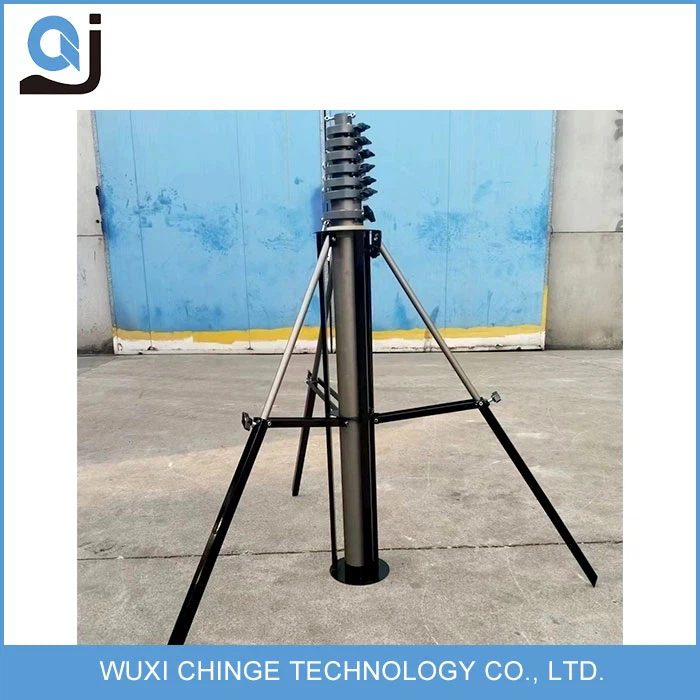
We understand that different applications have different needs. Maybe you're in the event industry and need a mast that can be quickly set up and taken down with minimal effort. Or perhaps you're in the security business and need a robust mast that can support heavy - duty surveillance equipment. Whatever your needs are, we have the right solution for you.
So, if you're interested in learning more about our crank up masts or if you want to discuss which mast would be the best fit for your project, don't hesitate to reach out. We're here to help you make the right choice and ensure that you get the most out of your mast.
In conclusion, the average force needed to crank up a mast varies widely depending on factors like the weight, length, friction, and design of the mast. But with our wide range of products and expert advice, you can find a mast that meets your needs without breaking your back.
References:
- Physics textbooks on mechanics and energy
- Industry - specific literature on mast design and operation