


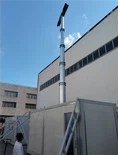

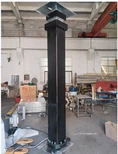
"Should we invest in a permanent cell tower, or would a Cell on Wheels Tower be enough?"
That's probably the question we've been asked most over the past few years.
Interestingly, the answer is rarely found in a product catalogue.
When customers contact us, they're usually expecting a comparison between two types of towers-height, loading capacity, installation time or price. Those factors matter, but they're not where experienced engineers start.
Instead, we ask a much simpler question:
"How long do you need communication coverage at this location?"
In our experience, that single answer often determines which solution makes the most sense. Everything else-tower height, trailer configuration, antenna capacity, even budget-comes afterwards.
If you're facing the same decision, here's how we evaluate it in real projects.
First, Forget the Towers. Look at the Project.
A few years ago, we worked with two customers almost at the same time.
One was building a new logistics park that would operate for at least twenty years.
The other was constructing a section of highway that would be completed in about fourteen months.
Both needed reliable LTE coverage for site management, surveillance cameras and equipment monitoring.
At first glance, their requirements looked almost identical.
Both asked about mobile communication towers.
Both requested quotations.
Both wanted the project completed as quickly as possible.
But the recommendations were completely different.
The logistics park eventually built a permanent cell tower.
The highway contractor chose a Cell on Wheels Tower.
Neither decision was based on the equipment itself.
It was based on how long the communication network would actually be needed.
That's why we always tell customers:
Don't choose the tower first. Define the project first.
When Does a Cell on Wheels Tower Make More Sense?
If your project has a clear end date, a Cell on Wheels Tower is usually the more practical investment.
We've seen this repeatedly on construction sites, mining projects, temporary military facilities, emergency rescue operations and large public events.
These projects all have one thing in common-they move.
Sometimes the entire site changes location every few months.
Sometimes communication is only needed during a festival or sporting event.
Sometimes it's impossible to wait for planning permission before restoring network coverage after a natural disaster.
In these situations, mobility becomes more valuable than permanence.
A trailer mounted tower can be transported to the site, deployed within hours and removed once the project finishes.
There's no concrete foundation to demolish.
No permanent land occupation.
No abandoned infrastructure after the work is complete.
One customer in Southeast Asia used the same portable telecom tower across five different construction projects in less than four years.
Had they built permanent towers at every location, most of those structures would now be standing on empty sites with no practical use.
When Is a Permanent Cell Tower the Better Choice?
That doesn't mean a Cell on Wheels Tower is always the right answer.
Sometimes mobility creates unnecessary cost.
If the communication demand will remain in exactly the same location for ten or twenty years, a permanent tower is usually the smarter investment.
Think about airports.
Industrial parks.
Urban telecom infrastructure.
Large manufacturing plants.
These aren't projects that move.
Once the tower is built, the network is expected to operate continuously for decades.
Although the initial construction cost is higher, the investment is spread over many years of stable operation.
In these cases, repeatedly maintaining or relocating a mobile solution simply doesn't make economic sense.
This is one reason telecom operators rarely see permanent and mobile towers as competitors.
They solve different problems.
One is designed for long-term infrastructure.
The other is designed for changing infrastructure.
The Biggest Mistake Buyers Make Isn't Choosing the Wrong Tower
It's predicting the wrong future.
We've seen customers insist they only needed temporary coverage.
Three years later, they're still operating from the same location.
We've also seen companies spend months building permanent infrastructure, only to relocate their operations less than two years afterwards.
Neither situation is unusual.
That's why we spend more time discussing project plans than discussing tower specifications.
Questions like these are far more important than whether the mast reaches 25 or 30 meters.
Will the site still exist three years from now?
Is relocation likely?
Will communication demand increase or decrease?
Can permits be obtained quickly?
Is future expansion already planned?
These answers usually determine which solution delivers the better return on investment.
Don't Compare Purchase Price-Compare Project Cost
Another misunderstanding is focusing only on the quotation.
A Cell on Wheels Tower may initially appear more expensive than expected.
A permanent tower may appear surprisingly affordable.
Neither impression tells the whole story.
A permanent tower involves land preparation, civil engineering, concrete foundations, cranes, local approvals and construction time.
Those costs don't always appear in the equipment quotation, but they are still part of the project budget.
A mobile cell tower, on the other hand, avoids most of those expenses.
More importantly, it becomes an asset that can be reused.
Once one project finishes, the tower simply moves to the next location.
Several of our customers calculate investment this way.
They don't ask,
"How much does the tower cost?"
They ask,
"How many future projects can this tower support?"
That's a very different way of thinking-and usually a much better one.
What We Usually Recommend
After supplying Cell on Wheels Towers for telecom operators, contractors, government agencies and emergency response teams, we've found that there isn't a universal answer.
Instead, we follow a simple rule.
If the project is temporary, the communication solution should be temporary.
If the project is permanent, the infrastructure should also be permanent.
Everything else is just engineering detail.
Before recommending any mobile telecom tower, our team at Wuxi Qinge Technology Co., Ltd. normally asks customers about the project timeline, deployment environment, communication equipment and relocation plans.
Only after those questions are answered do we begin discussing mast height, payload or trailer configuration.
It's a slower conversation than simply sending a quotation-but it usually prevents expensive mistakes later.
Final Thoughts
If you're comparing a Cell on Wheels Tower with a permanent cell tower, don't start with technical specifications.
Start with one simple question:
Will your project still be operating at the same location five years from now?
If the answer is yes, permanent infrastructure is often worth considering.
If the answer is uncertain-or definitely no-a Cell on Wheels Tower is likely to provide greater flexibility, faster deployment and a better long-term return.
After years of supporting temporary communication projects, we've learned that successful network planning isn't about choosing the biggest tower or the lowest price. It's about matching the communication solution to the way your project actually works.