


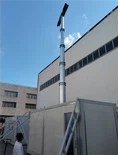

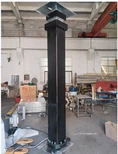
One question we often hear from new customers isn't "What is a Cell on Wheels Tower?" It's much more practical:
"Where does a Cell on Wheels Tower actually make sense?"
It's a fair question because not every project needs a mobile communication tower. If reliable telecom infrastructure already exists, adding a temporary tower may simply increase costs without creating much value.
But over the years, we've also seen projects where a Cell on Wheels Tower (COW Tower) prevented communication failures that could have delayed construction, disrupted public events, or slowed emergency response.
From our experience, the best applications all have one thing in common:
The communication demand changes faster than permanent infrastructure can be built.
Here are the situations where a Cell on Wheels Tower usually delivers the greatest value.
1. Emergency Response: When Every Hour Matters
If you've ever been involved in disaster recovery, you'll know communication is one of the first systems that needs to come back online.
After severe storms, floods or earthquakes, permanent cell towers may be damaged, power supplies interrupted, or fiber connections completely lost. Repairing fixed infrastructure can take days or even weeks, but rescue teams need reliable communication immediately.
This is exactly where a rapid deployment tower proves its value.
We once discussed a flood recovery project with a contractor who initially focused on tower height. After reviewing the site conditions, our engineers suggested spending less time worrying about mast height and more time considering road access.
The biggest challenge wasn't signal coverage-it was getting equipment into the disaster area quickly.
In emergency projects, the ability to tow a trailer mounted tower into position and restore temporary cellular coverage within hours is often far more important than installing the tallest tower available.
2. Large Events: Temporary Crowds Create Permanent Problems
Most stadiums, exhibition centers and parks already have mobile network coverage.
The problem isn't coverage.
It's capacity.
When fifty thousand people arrive at the same location, thousands of phones begin uploading videos, sharing photos and making calls simultaneously.
The existing network, which performs perfectly on ordinary days, suddenly reaches its limit.
We've seen this happen during music festivals, marathons and outdoor exhibitions.
Once the event ends, network traffic immediately returns to normal.
Building a permanent telecom tower for a three-day event simply doesn't make economic sense.
Instead, operators deploy a Cell on Wheels Tower to increase network capacity exactly where it's needed.
After the event, the equipment moves to the next location.
This flexibility is one of the biggest reasons why mobile cell towers are widely used for temporary public events.
3. Construction Sites: Because the Project Never Stays in One Place
Construction companies often ask whether they really need a portable telecom tower.
Our answer is usually another question:
"Will your site still be here in two years?"
For many infrastructure projects, the answer is no.
Highway construction moves forward section by section.
Railway projects expand continuously.
Pipeline construction can stretch hundreds of kilometers.
Mining operations gradually shift as excavation progresses.
Installing a permanent telecom tower for every work area simply isn't practical.
Instead, contractors relocate the same mobile communication tower as the project advances.
One customer working on a large highway project told us that the tower was relocated five times during construction.
Without a mobile solution, they would have needed multiple fixed installations, each requiring foundations, permits and additional investment.
Sometimes mobility is the biggest advantage-not because moving is convenient, but because the project itself never stops moving.
4. Remote Industrial Projects: Building Infrastructure Isn't Always the Priority
Oil fields, wind farms, solar plants and mining sites often share one challenge-they're located far from existing telecom infrastructure.
Communication is still essential.
Engineers need data.
Supervisors rely on video monitoring.
Equipment increasingly depends on remote diagnostics.
But building permanent communication infrastructure may not be justified during early project stages.
We've worked with customers who first deployed a Cell on Wheels Tower while construction was underway.
Only after the site became a long-term operation did they begin investing in permanent telecom facilities.
Using a mobile telecom tower as a temporary solution allowed the project to start months earlier without waiting for permanent infrastructure.
5. Network Maintenance and Temporary Capacity Expansion
Even established telecom operators regularly use Cell on Wheels Towers.
Not because something has gone wrong.
Because networks require maintenance.
Replacing antennas, upgrading equipment or expanding 5G coverage sometimes requires existing base stations to be taken offline temporarily.
Rather than leaving customers without service, operators deploy a mobile cell tower nearby to maintain coverage until work is complete.
The same approach is often used during holiday travel periods when temporary traffic increases overload existing networks.
In these situations, mobility isn't replacing permanent infrastructure.
It's supporting it.
What All Successful Projects Have in Common
Although these projects look completely different, they usually share the same characteristics.
Communication is needed quickly.
The location may change.
Building permanent infrastructure isn't practical.
Deployment time directly affects project progress.
Whenever these conditions exist, a Cell on Wheels Tower often becomes the most efficient solution.
On the other hand, if communication demand is expected to remain unchanged for decades, a permanent tower is usually the better long-term investment.
The application should always determine the equipment-not the other way around.
Choosing the Right Tower Starts With Understanding the Job
At Wuxi Qinge Technology Co., Ltd., we don't usually begin by asking customers how tall they want the tower to be.
Instead, we ask where it will be used.
A flood recovery project has completely different requirements from a concert.
A mining operation faces different challenges from a temporary 5G expansion project.
Understanding the application allows us to recommend the appropriate Cell on Wheels Tower, telescopic mobile tower, payload capacity and trailer configuration based on the actual working environment rather than simply selecting the largest model.
In our experience, that's the difference between a tower that simply works and one that continues to perform reliably throughout the entire project.
Final Thoughts
A Cell on Wheels Tower isn't designed to replace every permanent cell tower. It's designed to solve the situations where fixed infrastructure can't respond quickly enough.
Whether supporting emergency communication, expanding capacity for large events, connecting remote construction sites or maintaining network service during upgrades, the real advantage isn't just mobility-it's flexibility.
After years of supporting customers across telecom, infrastructure and industrial projects, we've found that the most successful deployments begin with one simple question:
"What does this project actually need over the next six months?"
Once that question is answered, the right communication solution usually becomes clear.