


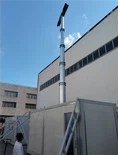

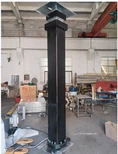
A few years ago, a customer sent us an inquiry for a 30-meter Cell on Wheels Tower.
Like many buyers, he had already decided what he wanted before discussing the project.
So we asked a simple question:
"Why 30 meters?"
His answer was straightforward:
"Because taller must be better."
Three weeks later, after reviewing the site, antenna configuration and transportation requirements, he purchased a 20-meter tower instead.
Not because of budget.
Because it was the right solution.
That's one of the biggest misconceptions in the industry. Many buyers focus on specifications before understanding what those specifications actually mean in the field.
After working on mobile communication tower projects for years, we've found that choosing a Cell on Wheels Tower (COW Tower) comes down to four critical factors:
Height
Payload
Trailer configuration
Wind rating
Get these four right, and the project usually runs smoothly.
Get one of them wrong, and even the best tower can become a problem.
Step 1: Start With Height-But Don't Start With Maximum Height
The first specification most buyers look at is tower height.
That's understandable.
Higher towers generally provide better line-of-sight coverage and improve antenna performance.
But height should never be selected in isolation.
We often see customers requesting a 25-meter or 30-meter telescopic mobile tower before they've even chosen the antennas.
That's backwards.
A better question is:
"How high does my equipment actually need to be?"
For example:
Temporary event coverage may only require 15-20 meters.
Construction sites often use 20-25 meters.
Remote LTE or 5G deployments may require 25-30 meters depending on terrain.
A tower that's taller than necessary creates additional transportation challenges, increases wind loading and may require a larger trailer.
In most projects, the goal isn't to buy the tallest tower.
The goal is to achieve reliable temporary cellular coverage with the most practical tower.
Step 2: Payload Capacity Matters More Than Many Buyers Realize
If height is the most visible specification, payload is often the most overlooked.
A Cell on Wheels Tower doesn't just support itself.
It must also support everything mounted on it.
That may include:
LTE antennas
5G antennas
Microwave dishes
CCTV cameras
Wireless transmission equipment
Lighting systems
A mistake we occasionally see is customers planning future equipment additions without considering payload requirements.
The tower works perfectly on day one.
Six months later, additional antennas are installed and suddenly the loading calculations change completely.
One mining project originally required only two sector antennas.
By the second year, surveillance cameras and microwave equipment had been added.
Fortunately, the tower had enough reserve payload capacity from the beginning.
Otherwise, replacing the entire mast would have been necessary.
Whenever evaluating a mobile telecom tower, always consider not only current equipment but future upgrades as well.
Step 3: Choose the Trailer Based on Where It Will Travel
This is where many purchasing decisions become expensive.
Buyers spend hours comparing mast specifications and almost no time considering the trailer.
Yet in reality, the trailer determines whether the tower can actually reach the jobsite.
A trailer mounted tower used on paved roads has very different requirements from one operating in mining areas, oil fields or remote construction sites.
Before selecting a trailer, ask yourself:
How often will the tower move?
What type of roads will it travel on?
Is off-road capability required?
What towing vehicles are available?
Are there transportation restrictions?
We've seen projects delayed not because of the tower itself, but because the trailer couldn't access the final deployment location.
The tower may be perfect on paper.
If it can't reach the site, none of the specifications matter.
Step 4: Wind Rating Is Usually the Last Question-But It Should Be One of the First
If there's one specification that experienced engineers pay attention to immediately, it's wind rating.
The reason is simple.
Wind doesn't care how much the tower costs.
It doesn't care how advanced the communication equipment is.
Once the mast is fully extended, wind becomes one of the primary forces acting on the entire structure.
What many first-time buyers don't realize is that antennas often create more wind load than the tower itself.
A tower that performs perfectly with a light antenna configuration may behave very differently when supporting multiple antennas and microwave dishes.
One customer told us:
"The average wind speed here is low, so we're not worried."
Our response was:
Average wind isn't usually the problem. Sudden gusts are.
That's why a proper wind rating must always be evaluated together with mast height, antenna size and payload.
Ignoring wind conditions is one of the fastest ways to create deployment problems.
Why There Is No "Best" Cell on Wheels Tower
After supplying mobile cell towers for telecom operators, construction companies, emergency response organizations and infrastructure contractors, we've learned that there is no universal solution.
The best tower for a disaster recovery project may be completely wrong for a long-term construction site.
The ideal tower for an outdoor event may not work for a mining operation.
That's why we rarely begin discussions with specifications.
Instead, we start with questions:
- How long will the project last?
- What equipment will be installed?
- How often will the tower move?
- What are the local wind conditions?
- How quickly must deployment be completed?
Once those answers are clear, selecting the right Cell on Wheels Tower becomes much easier.
Final Thoughts
Many buyers assume choosing a Cell on Wheels Tower is about comparing technical data sheets.
In reality, it's about understanding the project.
Height affects coverage.
Payload determines what equipment the tower can support.
The trailer affects mobility.
Wind rating affects safety and reliability.
When these four factors are considered together, the result is usually a tower that performs well not just during installation, but throughout the entire project lifecycle.
At Wuxi Qinge Technology Co., Ltd., we've found that the most successful deployments don't happen because customers choose the biggest tower available. They happen because the tower is matched to the real conditions on site.