


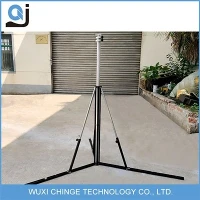


Can I use a hydraulic system to crank up the mast? This is a question that often pops up in the minds of those involved in industries that rely on telescopic masts for various applications. As a leading supplier of crank up masts, I've encountered this query numerous times, and today, I'm here to delve into the topic in detail.
Understanding the Basics of Crank Up Masts
Before we explore the feasibility of using a hydraulic system to crank up the mast, let's first understand what a crank up mast is. A crank up mast, also known as a telescopic mast, is a vertically extendable structure that can be raised and lowered to different heights. These masts are commonly used in a wide range of applications, including telecommunications, surveillance, lighting, and military operations.
There are several types of telescopic masts available in the market, each with its own unique features and advantages. Some of the most common types include Manual Telescopic Mast, Mechanical Telescopic Mast, Motorized Telescoping Antenna Mast, Portable Light Tower, and Telescopic Aluminum Mast.
The Traditional Cranking Mechanism
The traditional method of raising and lowering a crank up mast involves a manual or mechanical cranking mechanism. In a manual telescopic mast, the user turns a crank handle to extend or retract the mast sections. This method is simple, reliable, and cost-effective, making it a popular choice for many applications.
On the other hand, a mechanical telescopic mast uses a gearbox or a pulley system to convert the rotational motion of the crank into linear motion, allowing for more efficient and precise operation. These masts are often used in applications where higher lifting capacities and greater stability are required.
The Potential of Hydraulic Systems
While the traditional cranking mechanisms have served their purpose well, there is growing interest in using hydraulic systems to crank up the mast. Hydraulic systems offer several advantages over traditional methods, including increased lifting capacity, smoother operation, and greater control.
One of the key benefits of using a hydraulic system is its ability to generate a large amount of force with relatively little effort. This makes it ideal for applications where heavy loads need to be lifted or where the mast needs to be extended to greater heights. Additionally, hydraulic systems provide smooth and continuous motion, reducing the risk of jerks or sudden movements that could damage the mast or its components.
Another advantage of hydraulic systems is their ability to provide precise control over the lifting process. With a hydraulic system, the operator can easily adjust the speed and direction of the mast's movement, allowing for more accurate positioning and alignment. This is particularly important in applications where the mast needs to be positioned precisely, such as in telecommunications or surveillance.
Considerations for Using a Hydraulic System
While hydraulic systems offer many benefits, there are also some considerations that need to be taken into account before deciding to use one to crank up the mast. One of the main considerations is the cost. Hydraulic systems are generally more expensive than traditional cranking mechanisms, both in terms of the initial purchase price and the ongoing maintenance costs.
Another consideration is the complexity of the system. Hydraulic systems require more components and a more sophisticated control system than traditional cranking mechanisms, which can make them more difficult to install and maintain. Additionally, hydraulic systems require a source of power, such as an electric motor or a hydraulic pump, which can add to the overall cost and complexity of the system.
Finally, it's important to consider the environmental conditions in which the mast will be used. Hydraulic systems are sensitive to temperature and humidity, and they may not perform well in extreme conditions. Additionally, hydraulic fluids can be hazardous to the environment if they are not properly disposed of, so it's important to ensure that the system is designed and maintained in accordance with environmental regulations.
Conclusion
In conclusion, the question of whether you can use a hydraulic system to crank up the mast depends on several factors, including the specific application, the lifting capacity required, the budget, and the environmental conditions. While hydraulic systems offer many advantages over traditional cranking mechanisms, they also require careful consideration and planning to ensure that they are the right choice for your needs.
As a trusted supplier of crank up masts, we have extensive experience in designing and installing both traditional and hydraulic systems. If you're considering using a hydraulic system to crank up your mast, we encourage you to contact us to discuss your specific requirements. Our team of experts will be happy to provide you with more information and help you make an informed decision.

