


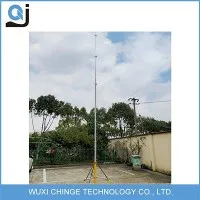
Calculating the pulling capacity needed to winch up a pole is a crucial aspect for various applications, from construction sites to communication setups. As a supplier of winch up poles, I understand the significance of accurate calculations to ensure the safety and efficiency of the operation. In this blog post, I'll guide you through the process of determining the appropriate pulling capacity for your winching needs.
Understanding the Basics
Before diving into the calculations, it's essential to grasp a few fundamental concepts. The pulling capacity of a winch refers to the maximum weight it can safely handle while winching. This capacity is influenced by several factors, including the weight of the pole, the angle of the winch cable, and any additional resistance encountered during the process.


Factors Affecting Pulling Capacity
Weight of the Pole
The most obvious factor is the weight of the pole itself. Heavier poles require more pulling force to be winched up. To determine the weight of the pole, you can use the material's density and the pole's dimensions. For example, if you have a steel pole, you can find the density of steel in a reference table and multiply it by the volume of the pole (calculated based on its length, diameter, and wall thickness).
Angle of the Winch Cable
The angle at which the winch cable is attached to the pole also plays a significant role in the pulling capacity. A cable at a steeper angle will require more force to lift the pole compared to a cable at a shallower angle. This is because the vertical component of the pulling force decreases as the angle increases. To account for this, you need to calculate the effective pulling force based on the angle of the cable.
Additional Resistance
In addition to the weight of the pole and the angle of the cable, there may be other sources of resistance that need to be considered. These can include friction between the pole and the ground, wind resistance, and any obstacles in the path of the pole. While it can be challenging to accurately quantify these factors, it's important to make reasonable estimates to ensure that the winch has enough capacity to overcome them.
Calculating the Pulling Capacity
Now that we understand the factors affecting pulling capacity, let's go through the steps to calculate it.
Step 1: Determine the Weight of the Pole
As mentioned earlier, calculate the weight of the pole based on its material and dimensions. For example, if you have a wooden pole with a length of 10 meters, a diameter of 0.2 meters, and a density of 600 kg/m³, the volume of the pole can be calculated using the formula for the volume of a cylinder: V = πr²h, where r is the radius (half of the diameter) and h is the height (length) of the pole.
V = π(0.1)²(10) = 0.314 m³
The weight of the pole can then be calculated by multiplying the volume by the density:
Weight = 0.314 m³ x 600 kg/m³ = 188.4 kg
Step 2: Calculate the Effective Pulling Force
Next, you need to calculate the effective pulling force based on the angle of the winch cable. The effective pulling force is the vertical component of the total pulling force exerted by the winch. You can use trigonometry to calculate this.
Let's assume that the winch cable is attached to the pole at an angle of 30 degrees. The effective pulling force (F_effective) can be calculated using the formula:
F_effective = F_total x sin(θ)
where F_total is the total pulling force exerted by the winch and θ is the angle of the cable.
If we want to lift the 188.4 kg pole vertically, the total pulling force required (ignoring additional resistance for now) can be calculated using the formula:
F_total = Weight x g
where g is the acceleration due to gravity (approximately 9.81 m/s²).
F_total = 188.4 kg x 9.81 m/s² = 1848.2 N
The effective pulling force at a 30-degree angle is then:
F_effective = 1848.2 N x sin(30°) = 924.1 N
Step 3: Account for Additional Resistance
As mentioned earlier, there may be additional sources of resistance that need to be considered. A common way to account for this is to add a safety factor to the calculated pulling force. A safety factor of 1.5 to 2 is typically recommended to ensure that the winch has enough capacity to handle any unexpected resistance.
Let's assume a safety factor of 1.5. The final pulling force required would be:
Final pulling force = F_effective x Safety factor
Final pulling force = 924.1 N x 1.5 = 1386.2 N
Step 4: Select the Appropriate Winch
Once you have calculated the pulling force required, you can select a winch with a pulling capacity that is equal to or greater than the calculated value. It's important to choose a winch from a reputable manufacturer to ensure its reliability and safety.
Our Product Offerings
As a leading supplier of winch up poles, we offer a wide range of high-quality products to meet your specific needs. Our poles are designed and manufactured to the highest standards, ensuring durability and performance.
We also provide a variety of winches with different pulling capacities to ensure that you can find the right one for your application. Whether you need a small winch for a lightweight pole or a heavy-duty winch for a large pole, we have you covered.
In addition to our winch up poles and winches, we also offer Electric Telescopic Mast, Telescoping Mast For Antenna, and Hand Push Up Telescopic Mast. These products are designed to provide reliable and efficient solutions for a variety of applications, including communication, surveillance, and lighting.
Contact Us for Purchase and Consultation
If you're in the market for a winch up pole or related products, we would be happy to assist you. Our team of experts can provide you with detailed information about our products, help you calculate the pulling capacity needed for your specific application, and answer any questions you may have.
Contact us today to start the conversation about your winching needs. We look forward to working with you to provide the best solutions for your projects.
References
- "Engineering Mechanics: Statics" by J.L. Meriam and L.G. Kraige
- "Strength of Materials" by Ferdinand P. Beer, E. Russell Johnston Jr., and John T. DeWolf
- Manufacturer's specifications for winches and poles